

One HVAC contractor spent eighteen months paying for a full site rebuild, a broad SEO retainer, and a stream of generic blog posts about furnace maintenance. Traffic climbed. Nobody could say which visits turned into a service call, a booked replacement, or a maintenance contract. When the retainer came up for renewal, the only evidence offered was a rankings report and a traffic graph, both trending upward, neither connected to a single job on the books.
That pattern is common because rankings and traffic are easy to show and hard to argue with, while the chain from a search to a signed work order is harder to build and easier to skip. The fix is not spending less on organic acquisition. It is refusing to fund the next dollar of it until the leak in the chain is located.
Diagnose The Organic Lead Ceiling
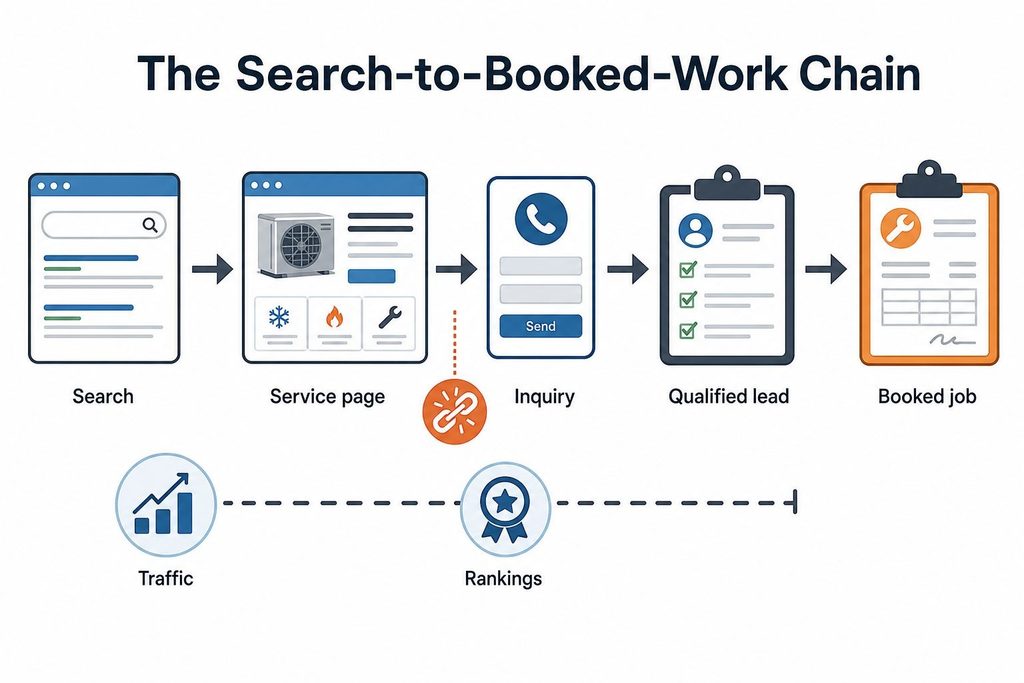
Scalable organic leads are not the same thing as organic visits. A scalable organic lead is non-branded service demand that can be traced from a specific search, through an inquiry, to work that actually gets booked. A homeowner searching for a same-day repair, clicking a service page, and calling the number on it is one link in that chain. A visitor arriving from a broad keyword, browsing the homepage, and leaving is not, even if the analytics dashboard counts both as sessions.
This distinction matters because most SEO spend gets judged against the wrong denominator. A contractor asking “did rankings improve” or “did traffic go up” is asking a question that a generic site redesign or a stack of blog posts can answer favorably without producing a single qualified call. The question that actually protects the budget is narrower: which searches, on which pages, produced which leads, and did those leads become jobs.
Worth has to be judged through the traced chain from search to booked work, not through a promise that SEO activity will produce a given result.
That reframing leads directly to a prioritization rule.
The 80/20 rule, applied to HVAC organic acquisition, means concentrating:
- page-building,
- local visibility, and
- technical fixes
on the limited set of:
- services,
- markets, and
- high-intent searches
most likely to move:
| lead volume | conversion rate |
|---|
rather than spreading effort evenly across every possible topic and location.
The evidence framework that supports this is not exotic: organic traffic, keyword rankings, conversion rate, lead volume, and search-to-job measurement. Each one answers a different question, and none of them substitutes for the others. The supplied research here reflects one unspecified market and language, with no competitor-level detail for any specific city or neighborhood, so nothing below should be read as a claim about a particular metro or a particular competitor’s ranking position.
Map High-Intent HVAC Searches
Before a single new page or blog post gets commissioned, the searches that actually precede a booked job need to be separated from the ones that only precede curiosity. Not every HVAC query carries the same commercial weight, and treating them as interchangeable is how budget gets spent on traffic that was never going to convert.
Separate Intent By Urgency And Stage
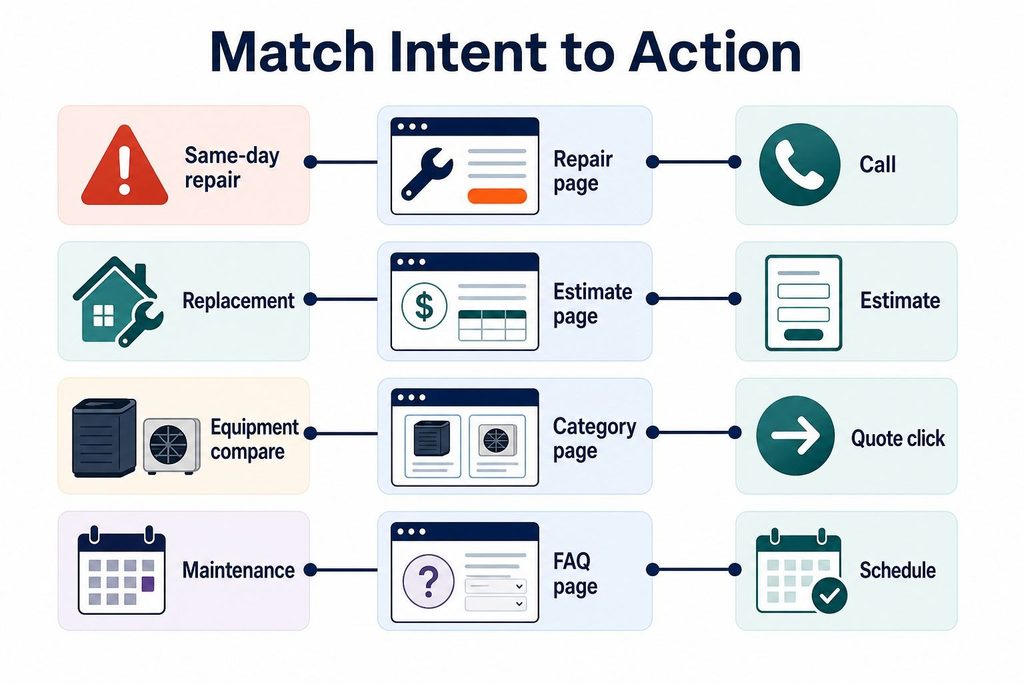
Four broad intent groups cover most HVAC search behavior: emergency or same-day service, replacement or new-installation research, equipment or brand comparison, and general informational questions. A search for a no-heat emergency behaves nothing like a search comparing two-stage versus variable-speed compressors, and a page built to satisfy one will underperform for the other.
Assign A Page And A Measurement Event
Each intent group needs its own landing page and its own defined conversion event, decided before content gets written, not discovered afterward by looking at what happened to rank.
| Search Intent | Representative Query Pattern | Matching Page | Lead Event To Record |
|---|---|---|---|
| Emergency or same-day service | “ac not cooling same day repair” | Emergency repair service page | Phone call from page |
| Replacement or installation | “new furnace installation cost” | Installation or replacement page | Form submission or estimate request |
| Equipment or brand comparison | “heat pump vs furnace efficiency” | Equipment category page | Click-through to quote page |
| Informational or decision-stage | “how often should ac be serviced” | Maintenance or FAQ page | Newsletter signup or booked maintenance visit |
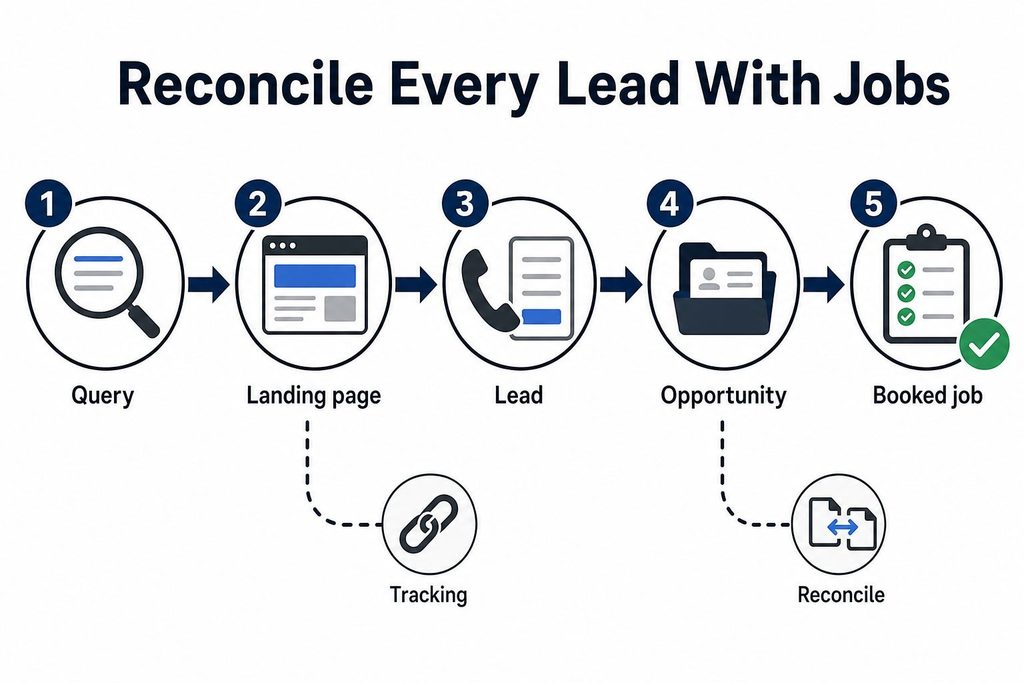
A compact working example makes the reconciliation concrete. A market-specific search for AC repair lands on the matching repair service page rather than the homepage, the visitor calls the number displayed on that page, and that call is later reconciled against the job record to confirm the search actually produced booked work, not just a completed call. Without that final reconciliation step, the call itself proves nothing about revenue.
Any agency or in-house effort that proposes new pages or content without first producing a keyword-and-intent map of this kind is asking to be funded on assumption. The map does not need to reference a specific competitor or a specific city to be useful. It needs to show, for the contractor’s actual services, which searches are being answered by which page today, and which are not being answered at all.
What Belongs On A Service Page
A service page earns its budget when it resolves a decision a homeowner is actually trying to make, not when it repeats a service name enough times to satisfy a keyword tool. Each page type carries its own obligations:
- Repair pages need to state the specific service and name the service area in terms a caller recognizes, not a boilerplate coverage list.
- Installation or replacement pages need proof relevant to that exact decision, such as warranty terms or financing, since the purchase is large enough to warrant it.
- Maintenance pages need a conversion path suited to a lower-urgency decision, typically a scheduling form rather than a phone number placed above everything else.
- Equipment category pages need enough comparative detail that a visitor can move to a quote without a phone call first.
- Internal links matter here as much as the copy itself. A replacement page that links to financing information and a maintenance page that links to a service plan are doing the work of moving a visitor toward a decision, while a page that only links back to the homepage is wasting the click.
- The distinction between an improvement and filler is a practical one, not a stylistic one. Adding a section that explains what determines whether a unit should be repaired or replaced, with the actual criteria a technician uses, clarifies a real decision. Adding another paragraph that restates “we offer heating and cooling services in [service area]” using slightly different words does not.
- Content ideas should come from the questions a technician actually gets asked on the job, the ones that come up right before someone books, rather than from a generic list of HVAC blog topics assembled without reference to what visitors on those specific pages are trying to decide.
Create Genuine Service-Area Architecture
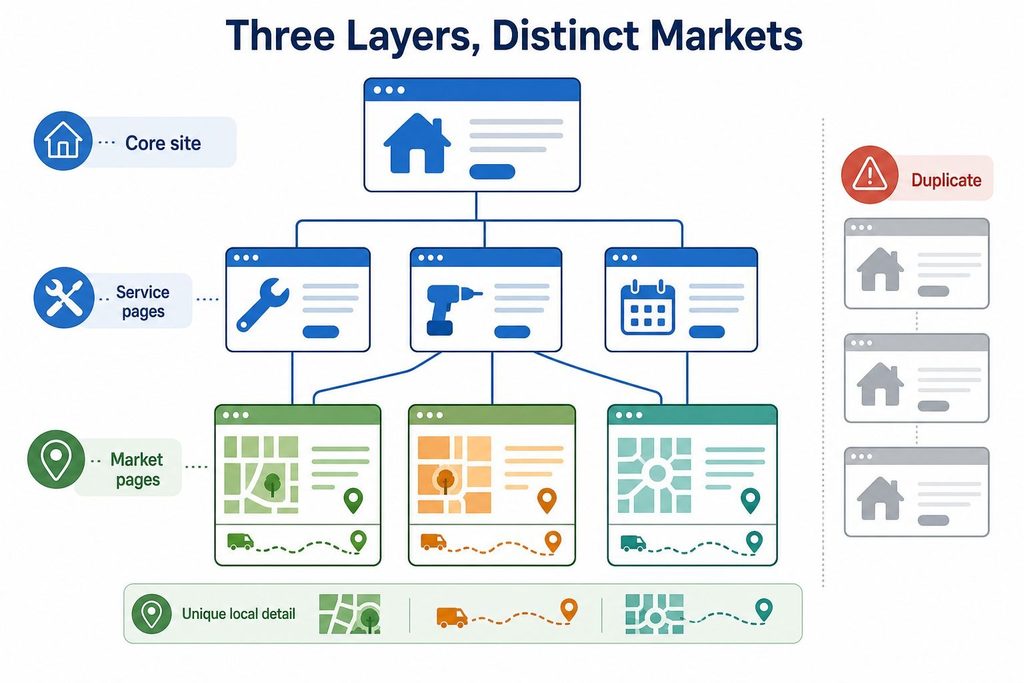
A contractor’s site typically has three layers: the core site describing the business overall, service pages describing what is offered, and market or location pages describing where it is offered. The failure point is treating the third layer as a formality, spinning up a page per zip code with the same three paragraphs and a swapped city name.
What A Location Page Actually Needs
Each market page needs content that would not make sense on a different market page: named neighborhoods or service zones, response-time expectations specific to that area, and, where relevant, a genuine operational reason the business serves that market, such as a satellite crew or a distribution point.
The 2026 HVAC SEO benchmark report referenced earlier in the intent discussion flags duplicate location pages specifically as a competitive weakness, and a page that could be copy-pasted across five towns by changing one word is exactly the pattern it is warning against.
What A Website Provider Must Be Able To Do
Choosing a website designer or agency for this work is a scope decision, not an aesthetic one. The provider needs to demonstrate real capability across four areas, not just a portfolio of finished sites:
- Intent-led page templates that differ structurally by search intent, not just by swapped headline text.
- Location architecture built to avoid duplication, with genuinely distinct content per market page.
- Mobile conversion paths wired correctly, including click-to-call and form tracking that survive the handoff.
- Measurement connected to each page type, so a lead can be traced back to the page and query that produced it.
A firm that proposes a visual refresh without addressing any of that is solving a different problem than the one costing leads. Firms offering seo for hvac contractors as a distinct service line, separate from design work, tend to be more explicit about which of these responsibilities they actually own.
A contractor operating in a single real market does not need this layer at all, and building it anyway is wasted spend. A contractor genuinely serving several distinct markets needs one page per market built to this standard, not a page per keyword variation of the same market.
Strengthen Google Business Profile Coverage
A well-built service page does not make a Google Business Profile optional, and a strong profile does not make service pages optional either. Maps visibility and organic service-page visibility answer different parts of the same search, and a contractor that only invests in one is leaving the other half of the result page uncontested.
- The primary category on the profile should reflect the principal service actually performed, not the service the business wishes it did more of. Services and service areas listed on the profile need to match what the service pages actually describe, because a mismatch between the two is a signal of low reliability rather than broad coverage.
- Review generation deserves its own operational routine, since reviews accumulated sporadically after a marketing push tend to plateau, while reviews requested as a standard step after every completed job compound over time. Adjusting the primary category to reflect a genuine seasonal shift in the principal service, from heating-related work in colder months to cooling-related work afterward, deserves a careful review of whether that shift is real for the business rather than a routine flip applied on a calendar regardless of actual demand.
The 2026 HVAC SEO benchmark report noted earlier also reports that local search drives a majority of HVAC organic leads and that Google’s Local 3-Pack captures meaningfully more clicks than listings ranked lower on the page. That observation is directional, not a benchmark for any specific market, and it does not guarantee a given contractor will see comparable results.
It supports treating local profile work as core spend, not as a line item to cut when a budget tightens.
Repair Technical SEO Before Scaling Content
Content and profile work cannot rescue a page that search engines cannot find, cannot load quickly, or cannot let a visitor act on. Technical faults sit underneath everything already covered, and fixing them comes before adding volume, because publishing more pages on top of a broken foundation multiplies the number of pages that fail rather than the number that convert.
Confirm Crawl And Indexation Are Sound
- An audit should confirm that service and location pages are indexable and carrying the correct canonical tag, that redirects and internal links still resolve correctly after any past redesign, and that structured data describing the business and its services is present where it is actually accurate rather than copied from a template.
- Page speed and rendering on mobile devices need direct checking, since a slow-loading service page loses the visitor before the proof or the phone number ever displays. Click-to-call and form tracking need to survive that mobile path intact, so a call placed from a phone is recorded with the same fidelity as a desktop form submission.
None of this requires a specific speed threshold to be useful as a diagnosis. It requires confirming that the pages meant to carry high-intent traffic are the ones actually reachable, fast enough to hold attention, and wired to record what happens next.
Measure Search-To-Job Results Before Renewing Spend
Proof, in this context, is not a rankings screenshot. It is a reconciled record connecting a landing page and the query theme that brought the visitor there, through the call or form submission, to a qualified opportunity, and where the contractor’s systems allow it, to the booked job itself. That reconciliation is the only evidence that answers whether the spend is working, and it is the evidence most retainers never produce.
Cost and agency fit belong in the same conversation as measurement, not a separate one. The questions that matter are procurement questions: what is in scope, who owns the page assets and the tracking data once the engagement ends, what reporting access the contractor retains, who is responsible for technical implementation versus content, and whether the agency is honest that no legitimate provider can guarantee rankings, call volume, or job count.
Before renewing any spend, run through this checklist in order. Each item is either done or it is not, and the order reflects how much damage skipping it does:
- Confirm the primary Google Business Profile category matches the principal service the business actually performs today. This takes under an hour and exposes the fastest fix available.
- Identify the highest-value unmapped intent: the service-market combination getting real search volume with no matching page.
- Verify one canonical page and one conversion event for that identified intent, end to end, before commissioning new content around it.
- Assign an owner responsible for reconciling that page’s leads against the actual job record, not just against a lead count.
The first item on that list is the one to do today.
About the Author