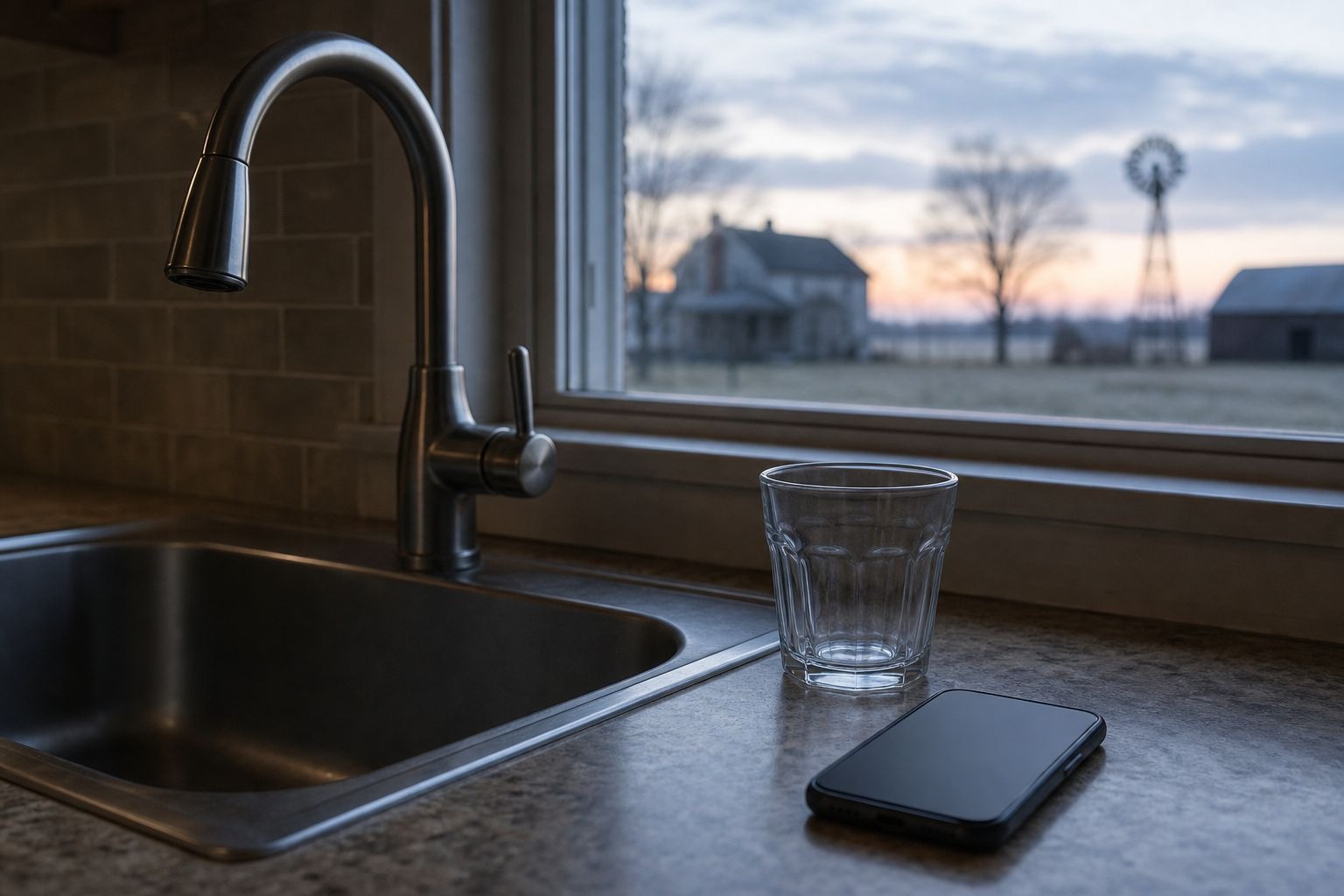
More marketing spend is not what fixes a missed emergency call. A well pump company can raise its advertising budget every quarter and still lose the customer standing in a dry kitchen at 6 a.m., because the call never had a path to reach a person who could book it.
That distinction matters more in rural service territory than almost anywhere else in home services. A property owner forty minutes from the nearest town does not have three well pump companies to compare on a drive down Main Street. They have a phone and a search bar, and whichever business answers both fastest tends to win the job regardless of how good the truck fleet is.
The order of operations, then, is not “spend more.” It is diagnose first, fix the cheap and structural problems, and only then decide whether paid visibility is worth buying.
Why Digital Visibility Matters When a Well Pump Fails
A household with no water does not wait for a referral. Well failures are rarely gradual: the pump trips, the pressure tank empties, and within an hour a property owner who has never needed a well contractor before is searching for emergency water system repair on a phone screen, often from a rural address with patchy connectivity. That search happens well before trust, brand familiarity, or word of mouth has any chance to operate. It is the first and sometimes only moment a company gets to be found.
The symptom that shows up on a well pump company’s books is simple: emergency inquiries arrive too few and too late relative to actual outage volume in the service area. The cause is not bad service or an inferior crew. It is that the business is not visible at the moment the search happens, across a service area that may span several counties with no obvious center of gravity.
A truck that is fast once dispatched is worthless if the call never arrives, or arrives forty minutes after a competitor already got the address.
The Emergency Search Path
The property owner’s path is short and unforgiving: search, scan two or three results, call the first number that looks like it will answer. There is no research phase, no comparison shopping, no waiting for a callback. Response time to that first contact functions as the deciding factor more than price or reputation.
The Measurable Business Case
The remedy is not a generic marketing package. It is a call-oriented acquisition system built around same-day water service and after-hours support, measured on the numbers that actually reflect emergency demand: website traffic during outage-prone periods, lead conversion rate on that traffic, and the volume of calls that convert into booked dispatches rather than voicemail.
Where Rural Emergency Repair Leads Get Lost
A lead can be lost at any point between the moment a property owner types “well pump not working” and the moment a truck is scheduled. In rural service territory the failure points multiply, because the service area itself is harder to define and the digital footprint is thinner than in a dense metro market.
Five failure points account for most of the leakage, and each one has a distinct symptom and a distinct fix rather than a single generic explanation.
| Stage | Visible Symptom | Likely Acquisition Cause | Measurable Signal |
|---|---|---|---|
| Outage search | Search shows competitors or nothing relevant | Service-area mismatch on listings and pages | Online visibility for county-level terms |
| Page landing | Visitor leaves within seconds | Weak emergency service pages, no clear next step | Website traffic with high exit rate |
| Contact attempt | Call goes unanswered or to voicemail | Unavailable call path outside business hours | Missed-call rate, response time |
| Trust check | Visitor calls competitor instead | Insufficient reviews or outdated profile | Customer reviews volume and recency |
| Booking | Call happens but source is unknown | Untracked source, no conversion tracking | Conversion tracking gaps |
The pattern worth noticing is that only one of these five failure points involves spending anything on advertising. The other four are structural, and they will undermine paid traffic just as thoroughly as they undermine organic search. A property owner who finds the business through a search ad but hits a page with no emergency language and no answered phone is still a lost lead, and a more expensive one than a lost organic visitor.
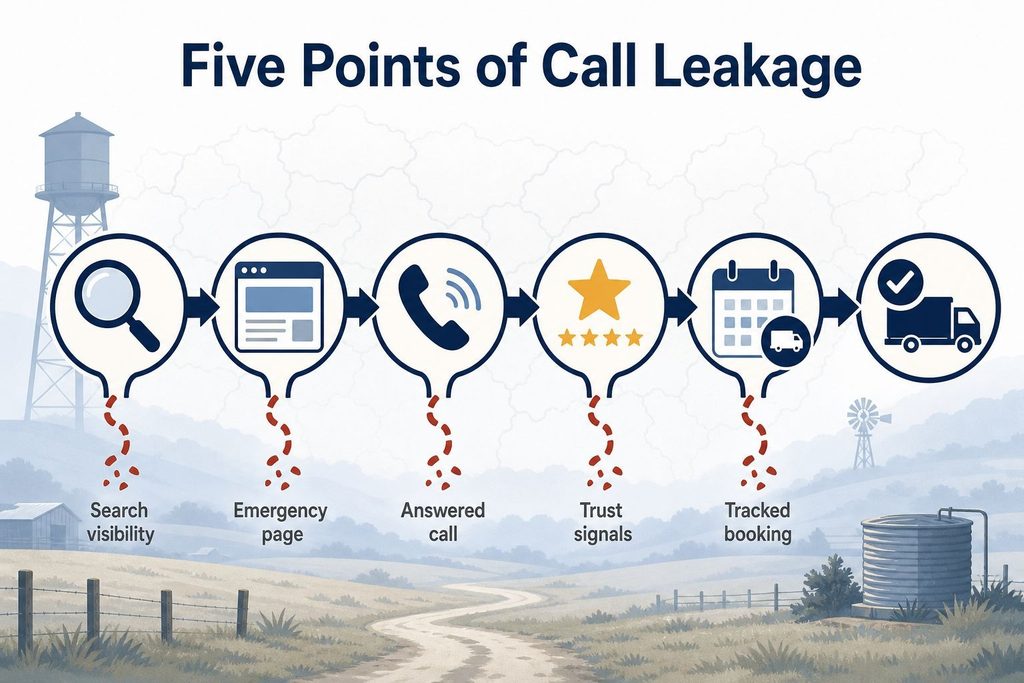
That is the case for sequencing. Fixing the call path and the service-area listing costs comparatively little and removes leakage that would otherwise waste every dollar spent afterward.
Which Investment a Well Pump Company Should Diagnose First
The decision in front of the payer is not “which channel works best.” It is which weakness is costing bookings right now, and that question is answered with a diagnosis, not a purchase.
The cheapest diagnostic available is reviewing what already exists:
- Call logs, to see how many inbound calls go unanswered or unreturned
- Conversion tracking, whatever is currently in place, to see if a booked job can be traced back to its source
- Service-area accuracy, checking whether listed coverage matches the counties actually served
- The emergency path itself, whether the Google Business Profile and website present a route a stressed caller can find in seconds
That review costs staff time, or the attention of whoever already manages analytics. It does not require a media budget.
Once that diagnosis is done, the remaining investments separate cleanly by cost form rather than by marketing category. Owned-channel fixes and local search work are largely internal labor and one-time implementation: correcting service-area listings, rewriting emergency pages, clarifying after-hours phone status. Review generation is ongoing management, a recurring but modest task. Paid search is the only category that is pure media spend, purchased per click, with no floor on the money that can be committed.
Each measure resolves a different uncertainty. Internal fixes resolve whether the business can be found and reached at all. Reviews resolve whether a stranger trusts it fast enough to call. Paid search resolves nothing structural. It only adds volume to whatever path already exists, for better or worse.
How Local Search Captures No-Water Calls Across a Service Area
Local search matters most for urgent queries precisely because urgency strips away comparison shopping. A property owner searching “well pump replacement near me” or “no water emergency” is not building a shortlist. They want the first credible, answerable option, which means service-area clarity and an unambiguous phone path carry more weight than design polish or brand messaging.
A 2026 local SEO guide for well drilling and water well companies argues that defining every county and rural region actually served is foundational for this kind of work, since well service territories rarely map to a single city the way most local businesses do. Three actions follow directly from that:
- List every county and rural region served explicitly, rather than relying on a single city name that undersells the actual coverage area.
- Align the Google Business Profile and emergency-service pages with the terms property owners actually use: well pump repair, low water pressure, well pump replacement.
- Make the phone path and after-hours status unmistakable, so a caller at 11 p.m. knows within seconds whether the line is answered or forwards to voicemail.
Service-Area Clarity
None of this guarantees a ranking position. What it does is remove ambiguity that causes a legitimate searcher to bounce to a competitor whose coverage area is easier to confirm.
Emergency Conversion Paths
The outcomes worth tracking are online visibility for the specific terms above, call volume tied to those terms, and lead conversion rate once the call connects, not a promised rank.
What Makes an Emergency Well Pump Service Credible Before the Call
Trust has to be established before the phone rings, because a property owner without water has no time to build it during the call itself. Customer reviews, accurate descriptions of what same-day service actually covers, and a stated response-time expectation all reduce the hesitation that sends a caller to the next search result instead.
Educational content about how well pumps fail and what a no-water emergency typically involves does the same work indirectly, by making the business look like it has handled the exact situation before.
That content has a firm boundary. EPA private-well guidance, state well-water regulations, and local plumbing codes are useful as context, showing that a company understands the regulatory environment its customers live in, but they are not instructions to be dispensed on a marketing page, and should never be presented as such.
Reviews and Reputation
Review volume and recency function as a proxy for reliability that a stressed caller can assess in seconds, and they are among the few trust signals measurable independent of any campaign.
Emergency Answer Content
Response-time expectations, stated plainly, convert hesitation into a call, and call outcomes are the number that confirms whether that promise held.
When Paid Search Earns Its Cost
Paid search is a lever for confirmed demand, not a fix for a broken funnel. A contractor PPC resource notes that:
- Google Ads can target high-intent searches
- with payment occurring only when someone clicks
- which suits urgent service categories like well pump repair
- but a click is not a booking, and paying for traffic that lands on an untracked page or reaches an unanswered phone simply moves the leakage upstream without curing it.
The spending sequence that limits that risk runs in order:
- Verify conversion tracking and call handling before any media dollars move, so every click can be traced to an outcome.
- Run tightly matched emergency well pump terms against the confirmed service area, avoiding broad terms that draw clicks from outside the counties actually served.
- Compare qualified calls and booked work against media spend and management cost on a recurring basis, not as a one-time check.
Each remedy carries a distinct cost form: tracking setup is largely staff time, media spend is charged per click with no guaranteed floor or ceiling, and ongoing campaign management is optional labor layered on top. None of those figures can be estimated responsibly without the diagnosis done first.
What Happens in the First Forty-Eight Hours
- Start by auditing emergency call routing and whatever conversion tracking already exists. No spending decision that follows can be judged without a recorded outcome to measure against, so this comes first regardless of what else feels urgent.
- Next, verify the actual service-area listing and the emergency wording on the Google Business Profile and the highest-traffic page. Both are low-cost fixes that remove ambiguity for a caller who has no patience to search further, and both can be corrected without waiting on any campaign decision.
- Then set one baseline, on either review activity or paid-search performance, before approving any additional spend beyond what is already committed. A baseline set after the audit and the listing fixes reflects the business as it will actually operate, not as it operated before the leaks were closed.
- The single next step is smaller than all three: assign one person, today, to place a test call through the current no-water emergency path and record exactly what happens.
About the Author