More content rarely fixes a weak map pack position. An HVAC company can publish a dozen new pages, none of them touching the three or four factors actually holding it out of the top results, and the phone still rings less than it should during a heat wave or a cold snap.
The instinct to write more is understandable. It feels like effort. But emergency search behavior is unforgiving: a homeowner with no heat at midnight is not reading a blog post, they are scanning three listings and calling one.
What moves that homeowner toward a call is a narrower set of decisions than most operators assume, made in a particular order.
What Local SEO Actually Needs to Deliver
Local search optimization, done properly, is the coordinated work of earning relevant visibility across Google Maps, Google Business Profile, and the company website. It is not a guarantee of a specific position, and no legitimate service can promise one.
What it produces, when the coordination holds, is a better chance of appearing where a caller is already looking: the three-listing map pack that shows up above organic results for searches tied to a location.
For an HVAC operator, the outcomes worth measuring are concrete: map pack ranking for emergency terms, actual completed calls for emergency ac repair and emergency heating repair, consistent presence across the company’s full service radius, and a steadier flow of local lead generation rather than a feast-or-famine pattern tied to weather spikes.
A detailed walkthrough of local seo for hvac lays out how these pieces fit together operationally, which matters because the pieces are frequently managed by different people inside the same company.
What Separates Map Visibility From Organic Visibility
Map pack results draw heavily on Google Business Profile signals, proximity, and category match. Organic results below the map draw more on site content, backlinks, and technical structure.
A company can rank well organically and still miss the map pack, or the reverse, because the two systems weigh different inputs.
What A Service-Area Company Can Actually Control
Profile accuracy, category selection, review response, service-page content, and citation consistency sit inside the company’s control. Proximity to the searcher and the searcher’s own query wording do not.
Protect The Budget From Low-Impact Activity
Spreading marketing spend across channels feels safe. It is not free of cost. Every dollar and hour sent toward a low-impact activity is a dollar not spent fixing the profile inconsistency or missing service page that is actually suppressing calls.
The visible damage shows up in a few consistent ways:
- missed urgent calls during peak weather
- business data that contradicts itself across directories
- work nobody can measure against a call outcome
- a rush into a new channel before the foundational one is functioning
| Investment Lane | Primary Job | When It Fits | Decision Risk |
|---|---|---|---|
| Local SEO Foundations | Fix profile accuracy, site structure, and citation consistency | Before any other spend, as the baseline layer | Skipping it weakens every other channel built on top |
| Paid Search | Buy immediate visibility for urgent, high-intent terms | Seasonal demand spikes or a new service radius | Cost per lead rises quickly without a strong landing page |
| Social Media | Build brand recall and community presence over time | Ongoing, secondary to search-based discovery | Rarely drives same-day emergency calls on its own |
| Outsourced Agency Support | Execute at a pace internal staff cannot sustain | Capacity or expertise gap, not a substitute for direction | Work quality varies without clear reporting tied to calls |
Paid search and social media are not replacements for the foundational work. They amplify a profile and website that already convert; they cannot compensate for one that does not.
Applying an 80/20 lens here means identifying which few assets, the Google Business Profile, the emergency service pages, and the citation set most connected to local discovery, deserve the concentrated attention.
It is not a formula that guarantees a ranking outcome. It is a way of refusing to spread limited hours evenly across everything that could theoretically help.
Complete The Google Business Profile Foundation
Google Business Profile and Google Maps deserve the first pass of attention because emergency searchers interact with them before they ever reach a website. A caller comparing three listings is reading the business name, the category, the hours, and the reviews in the space of a few seconds.
None of the edits below guarantee a ranking change. What they do is remove the specific errors that make a profile ineligible for map pack consideration or that erode a searcher’s trust once the listing appears.
Verify The Business Facts
- Confirm the profile is claimed and verified under a current, monitored account, not one tied to a former employee or agency contact
- Check that the business name matches the legal or commonly used trading name exactly, with no inserted keywords
- Confirm the phone number rings to a monitored line, not a disconnected forwarding number
- List the accurate service-area radius rather than a single storefront address if the company does not serve walk-in customers
Match The Service Signals
Profile accuracy connects to relevance, trust, and eligibility for map pack consideration. It does not connect to a promised position.
A profile with a wrong category or a stale phone number is disqualifying itself before the ranking system ever gets a chance to weigh anything else. Six adjustments cover most of what needs correcting:
- Set the primary category to the closest accurate match, such as HVAC contractor, rather than a broader or aspirational category
- Add emergency ac repair and emergency heating repair as named services where the profile’s service list allows it
- Note operating hours accurately, including any distinction between standard hours and after-hours emergency availability
- Write a business description that reflects the services actually performed, not generic industry language
- Upload current photos of trucks, technicians, and completed jobs rather than stock imagery
- Establish a routine for responding to reviews within a short, consistent window
Build Service Pages Around Local Repair Intent
Keyword research and thin location pages get confused with each other constantly, and the confusion produces exactly the kind of content that helps nothing.
Keyword research identifies what an emergency searcher actually types and why. Manufacturing a separate page for every town name inside a service radius, with the same three paragraphs reworded, produces pages that satisfy neither the searcher nor the ranking system evaluating them for substance.
Map Emergency Intent
Emergency searches carry distinct language worth separating deliberately: emergency ac repair versus routine maintenance, emergency heating repair versus a scheduled tune-up, and urgency modifiers like same-day or 24-hour attached to a system type such as furnace, heat pump, or central air.
A searcher typing “no heat emergency repair” is in a different mental state than one typing “annual furnace inspection,” and a site that treats both queries with the same page is missing the distinction that matters most at the point of conversion.
Service-radius language belongs here too, described honestly in terms of coverage rather than a fabricated list of neighborhoods the company has never actually served.
Publish Useful Local Evidence
A service page earns its place by doing something a generic homepage cannot. It states the specific service, the accurate coverage area, and a direct path to book or call, positioned where a reader does not have to search for it.
It answers the two or three questions an emergency caller actually has, cost expectations, response time, and what happens after the call, as a short FAQ rather than marketing copy. It shows evidence of capability: certifications, equipment brands serviced, or a description of the emergency dispatch process.
None of this is invented for the sake of populating a template. A company should build a page for emergency AC repair and a separate page for emergency heating repair, each reflecting the real service radius, because the two problems arrive in different seasons with different urgency signals.
Location-specific content of this kind can improve relevance and make the conversion path clearer once a visitor arrives. It is not a guaranteed ranking lever, and treating it as one leads back to the thin-page mistake this section opened by rejecting.
Repair The Business Data And Trust Signals
A phone number that is correct on the website and wrong on a directory is a common, quiet failure. It does not announce itself the way a broken link does.
It shows up as a searcher calling a disconnected line, or as a ranking system treating the business as less consistent than a competitor whose listings agree with each other everywhere.
Audit The Canonical NAP
A 2026 local SEO playbook recommends checking the canonical name, address, and phone details across Google, Apple Maps, Bing, Yelp, and Facebook on a recurring basis, then correcting whatever has drifted.
Directories and data aggregators pull from multiple sources and periodically reintroduce old information. This is not a one-time cleanup. It is a check worth repeating on a set schedule, because a single outdated citation can resurface months after it was corrected elsewhere.
Earn And Manage Reviews
Citations from relevant local sources and a small number of genuine local link opportunities add to the same consistency picture. Requesting a review shortly after a completed emergency job, while the relief of restored heat or cooling is still fresh, tends to produce a more detailed and useful response than a delayed request.
Responding to reviews factually, without defensiveness, treats the response itself as public information for the next searcher reading it.
All of this functions as a signal of trust, authority, and consistency. None of it is a promised map pack outcome on its own.
Measure The Calls That Local Visibility Produces
A strong map pack position that produces no calls is not a strong position, it is a vanity number. The business needs qualified emergency leads, and ranking is only useful as a proxy for that, never the target itself.
Track The Discovery Path
Worth tracking together:
- profile actions like requests for directions or calls initiated directly from Google Business Profile
- calls landing on the website’s own tracked number
- form submissions
- time spent on the emergency service pages specifically
Diagnose The Constraint
Low visibility with strong conversion once someone lands on the site points to a discovery problem, likely in the profile or citations. Strong visibility with weak conversion points to the service pages or the call-handling process itself.
Incomplete or contradictory data across the two makes either diagnosis unreliable, which is its own signal to fix the tracking first.
A monthly review, checked against the previous month rather than against an assumed competitor benchmark, is enough cadence to catch a slide before it becomes a season-long problem.
Allocate The HVAC SEO Budget By Constraint
A budget spent on a generic package solves nothing if the actual constraint is a wrong category on the Google Business Profile. Money should follow the specific gap, not a standard bundle sold the same way to every HVAC company regardless of what is actually broken.
Three branches cover most situations:
- Foundation repair applies when the profile has inaccurate or incomplete information, the site has technical gaps, or citations disagree with each other; this work is often one-time and comes before anything else gets funded.
- Ongoing local SEO applies once the foundation is sound and the need shifts to consistent optimization, content expansion, citation maintenance, review generation, and continued measurement over time.
- Agency evaluation applies when internal capacity cannot sustain the ongoing work regardless of how clear the plan is.
A 2025 HVAC pricing guide reported that:
- most residential HVAC companies spend $900 to $3,500 per month on ongoing local SEO,
- with larger or multi-market operators spending $3,500 to $7,500 or more,
- and one-time technical fixes or rebuilds running $2,000 to $10,000 or more.
A separate industry data set put average ongoing spend near $3,604 per month across roughly a thousand HVAC and home-services companies, a useful sanity check against a proposal that seems unusually low or high.
Lead cost matters as much as channel cost. A 2026 HVAC SEO guide, drawing on analysis of $14.9 million in HVAC ad spend across 816 contractors, found established organic SEO leads costing $10 to $30 each, compared with $149 per lead for non-branded Google Ads.
Neither figure forecasts a specific result for a specific company, and paid search still fills a role organic visibility cannot: immediate placement while the foundational work is still taking hold.
When evaluating an agency against any of these numbers, transparent scope, ownership of the company’s own access credentials, reporting tied to calls and leads rather than only to rank position, and an explicit refusal to promise rankings are the criteria that separate a functioning partnership from a wasted budget line.
Run The First Forty-Eight Hours Of Local SEO
Progress here shows up as verified facts, traceable actions, and a baseline worth comparing against later, not as an overnight jump in position. Anyone promising the latter is not describing how this works.
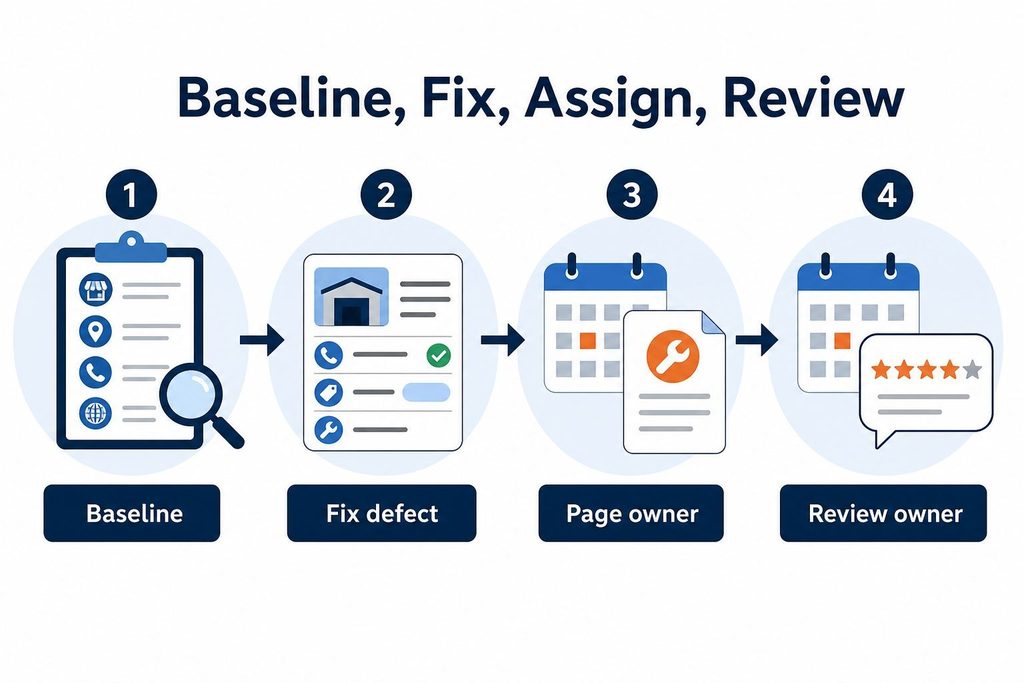
The sequence matters because it protects the work from itself. Four steps, done in order, cover the first two days:
- Record where things stand today. Current Google Business Profile details, current map pack presence for the core emergency terms, current call volume, and the existing NAP across major directories. Every later comparison depends on knowing the starting point, so this comes first even though it produces no visible change on its own.
- Fix the single highest-confidence defect. A wrong phone number, a stale category, a missing emergency service listing, whichever error is most clearly wrong and most clearly damaging. This comes second because correcting the known error before expanding into new pages or new citations prevents the same mistake from propagating into new content.
- Assign one person and one date to the emergency service page. A plan with no named owner and no date attached is a plan that stalls the moment the week gets busy.
- Assign one person and one date to the review-response workflow. This is separated from the service page ownership deliberately, since the two tasks pull on different skills and bottleneck at different points if left to the same person by default.
The action for today is narrower than all of that: pull up the Google Business Profile and check its contact number, category, listed services, and emergency-repair details against the canonical business record, line by line.
About the Author