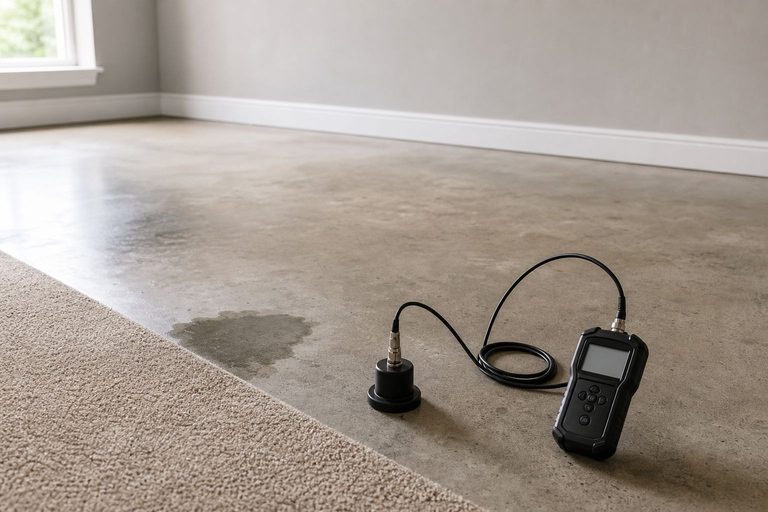
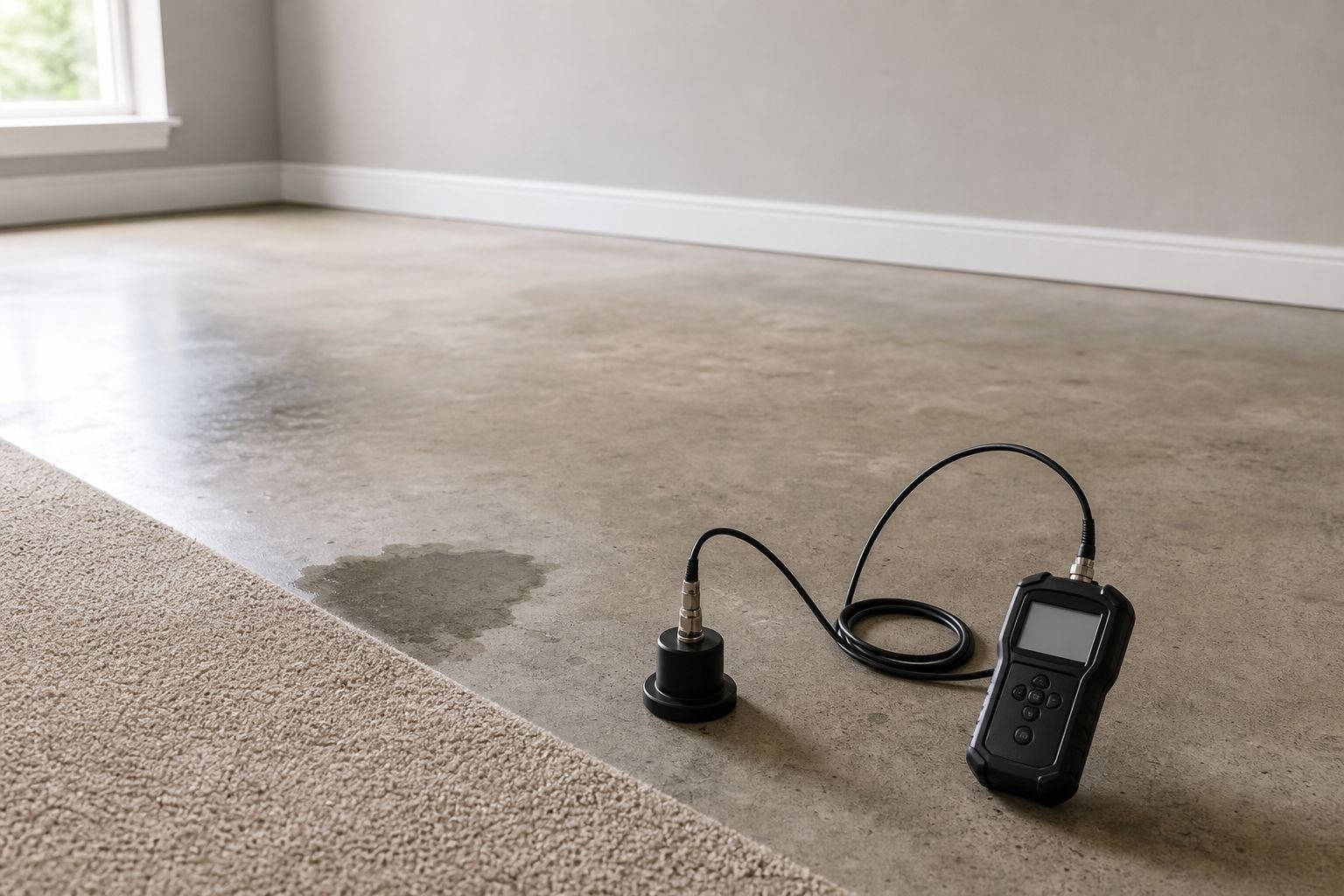
A campaign built around the word “plumber” produced forty-one calls in a month. Three turned into booked leak detection inspections. The rest were toilet clogs, water heater quotes, and one call about a leaking dishwasher that had nothing to do with slab or pipe leak work. The dispatcher spent hours qualifying calls that were never going to convert.
The spend behind those forty-one calls looked identical whether the caller needed a five-minute plumber or a certified leak detection specialist with acoustic equipment. This is common because broad plumbing keywords are cheap to rank for and easy to justify on a dashboard. Call volume goes up, and volume feels like progress even when almost none of it is inspection-ready.
Define Qualified Leak Detection Requests
A generic plumbing lead and a qualified leak detection request are not the same category of contact, even though both arrive as a phone call or a form. The plumbing lead usually names a visible, fixable symptom: a dripping faucet, a running toilet, a clogged drain.
The leak detection request, by contrast, describes:
- a symptom:
| the caller cannot see | and cannot diagnose alone |
|---|
- paired with:
- a location,
- a suspicion,
- and often some urgency about water damage already underway.
That difference in the caller’s own language is the clearest signal available before a technician is ever dispatched.
Intent for a qualified request has to be read against a short set of criteria:
- the location served
- the suspected symptom
- urgency
- property type
- the specific inspection needed
- whether the caller is ready to book rather than just browsing for information
Signals For Slab Leak Inspection
Searches and calls tied to slab leaks tend to mention a specific set of physical symptoms: warm patches on flooring, a spike in the water bill with no visible cause, the sound of running water when every fixture is off, or cracking in a foundation. These callers are usually residential, often anxious about cost, and close to ready to book once they trust the diagnosis process.
Signals For Hidden Pipe Leak Identification
Hidden pipe leak inquiries lean more on mold, musty smell, or unexplained damp drywall rather than foundation symptoms. Residential leak detection requests in this category often come from homeowners who have already called a plumber for something else and were told the real problem is upstream.
Commercial leak detection requests carry different urgency: a property manager reporting utility cost anomalies across multiple units, needing scheduling flexibility rather than same-day emergency service.
Expose the Cost of Broad Plumbing Targeting
A campaign built on the single word “plumber” or “plumbing services near me” pulls in every kind of plumbing need at once, from a five-minute faucet fix to a suspected slab leak. That undifferentiated pool of clicks looks efficient on a cost-per-click report and performs badly on a cost-per-qualified-inspection basis, because most of the traffic was never looking for leak detection in the first place.
The difference shows up clearly once the query signal is separated from the destination page it lands on.
| Query Signal | Likely Need | Destination Page |
|---|---|---|
| “plumber near me” | Faucet, toilet, drain repair, high qualification risk | Generic homepage or contact form |
| “water bill suddenly high” | Possible hidden leak, needs symptom confirmation | Should route to leak detection page, often does not |
| “slab leak inspection [city]” | Suspected slab leak, ready to book | Dedicated slab leak inspection page |
| “commercial water leak detection” | Facility-level leak, planned scheduling | Should route to commercial leak page, often missing |
Every click routed to the wrong page costs the same as one routed correctly, but only the correctly routed click has a chance of becoming a booked inspection. The wasted portion shows up as dispatch time spent qualifying calls that were never close to a fit, and as inspection demand that exists in the market but never gets captured because no page was built to receive it.
Build Search Paths Around Inspection Intent
Fixing the mismatch is not a matter of writing better ads on top of the same landing page. It requires building distinct paths so that a search for a slab leak symptom and a search for an emergency pipe burst do not compete for the same generic page, the same phone script, or the same follow-up email.
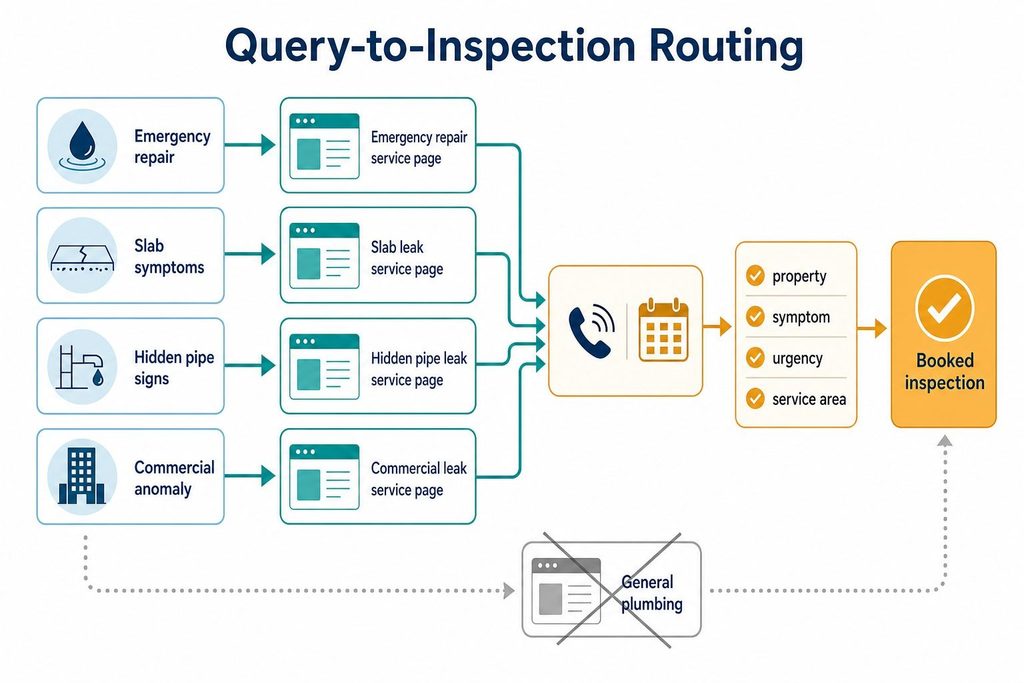
The build order matters less for creativity than for sequencing, since each step depends on the one before it existing first.
- Cluster the search terms by intent, grouping emergency leak repair queries separately from slab leak inspection, hidden pipe leak identification, and early leak detection terms, since these represent different urgency levels and different buyer readiness.
- Assign each cluster to one dedicated local service page, rather than folding all leak-related content into a single “plumbing services” page that dilutes every term’s relevance.
- Write the page copy around symptom and outcome, naming what the caller is likely seeing (a wet patch, a sound, a bill spike) and what the inspection process will determine, instead of listing services in the abstract.
- Give each page exactly one inspection-request action, whether that is a booking form or a direct call line, so the page does not split attention between selling a repair and booking a diagnostic visit.
Emergency Intent Pages
Emergency leak repair pages need to answer one question fast: how quickly can someone arrive. These pages should not try to also explain slab leak diagnostics in depth, because a caller with water actively pooling does not read a methodology section before dialing.
Planned Inspection Intent Pages
Slab leak inspection and hidden pipe leak identification pages serve a different reader, one who is investigating a suspicion rather than reacting to a flood. These pages carry more room to explain the inspection process itself, which matters directly for finding clients needing slab leak detection and targeting homeowners with hidden pipe leaks before the damage becomes an emergency.
Increasing slab leak inspection requests depends more on this page’s clarity than on ad spend, since a confused page loses a searcher who already had intent. Marketing for leak detection services succeeds or fails largely on whether these pages exist at all, separate from the general plumbing catalog.
Strengthen Local Proof Before Buying More Reach
Search terms and pages only carry a qualified request as far as the point where the searcher checks whether the business actually matches what they need locally. Service categories and service areas listed on a Google Business Profile have to agree with what the website claims, because a mismatch, even a small one, reads as uncertainty to someone deciding whether to call.
That agreement has to hold in two separate places before more traffic is worth buying.
Profile And Page Consistency
The service categories selected on the profile should include leak detection specifically, not just general plumbing, and the listed service area should match the cities named on the site’s local pages. Localized review evidence, meaning reviews that reference leak detection or slab leak work by name rather than generic plumbing satisfaction, gives a searcher comparable proof to what they are already reading on the page.
Mobile Booking Clarity
Most of this traffic arrives on a phone, often mid-search while standing over a wet patch of carpet. The inspection-request path, whether a tap-to-call button or a short form, needs to be visible without scrolling, and it needs to route to a person who can actually schedule a leak detection inspection rather than a general intake line.
Filter Calls Before They Reach Dispatch
None of the targeting work matters if every call that reaches dispatch still has to be manually sorted for fit. Lead qualification exists to catch the mismatch earlier, before a technician’s time or an ad dollar is spent finding out a caller wanted a drain snake, rather than a leak inspection.
A short intake flow, whether automated or scripted for a call handler, should capture:
- Property type, residential or commercial, since the two carry different scheduling and pricing expectations
- Suspected leak location, slab, wall, yard, or unclear, to route to the right specialist
- Symptom described, sound, damp area, bill spike, visible water, without assuming any symptom confirms an actual leak
- Urgency, active water damage versus a suspicion under investigation
- Service area, confirmed against the business’s actual coverage before scheduling
- Inspection versus repair need, since a caller who already knows they need a repair may not need a diagnostic visit at all
- Negative-keyword review, checking which search terms generated the call
- Missed-call routing, so an unanswered call to the leak detection line does not fall back into a generic queue
This flow has to preserve genuine residential and commercial leak detection requests even when the symptom is ambiguous, rather than screening out anyone who cannot describe the problem with certainty.
Differentiate Inspection Pages With Credible Methods
A service page earns trust partly through what it says about how an inspection actually works, not only through calls to action. Describing the method used is proof of capability, and it belongs on the page as context, not as the entire marketing strategy in place of a findable page or a working intake flow.
What Method Fits Which Symptom
Early leak detection and hidden leak pages can describe acoustic and infrared assessment where those methods are actually offered, giving a searcher a concrete sense of what the visit will involve.
Field testing across 27 sites, reported by researchers at Monash University, found that infrared leak detection accuracy clearly identified 59% of buried water leaks, with another 22% showing signatures that were notable but not conclusive. That range is worth stating plainly rather than rounding up into a universal accuracy claim.
Setting Expectations On The Page
A page that states the 59% figure alongside the 22% ambiguous range, rather than a single confidence number, gives a homeowner or property manager a realistic picture of what the visit can and cannot confirm on the first trip. That honesty is itself a qualification tool: a caller who understands an inspection may need a follow-up visit is less likely to treat a inconclusive result as a failed job.
From Explanation To Booking
The explanation should end at the same inspection-request action used elsewhere on the site, so a reader convinced by the method description does not have to hunt for how to book.
Measure Inspection Requests Instead of Raw Calls
Call volume alone cannot prove that qualified leak detection demand is growing, since a rising number of calls can just as easily mean a broader plumbing term is pulling in more mismatched traffic. Four points in the chain carry the tracking:
- which query or profile action originated the contact
- whether the click reached the correct service page
- whether the page visit converted into a booked inspection
- and whether the completed inspection confirmed a real leak needing service
Each point feeds the next decision. Source-level tracking shows where to adjust targeting. Page-level conversion review shows whether copy needs revision. The qualified opportunity count shows whether the intake flow is working. And the completed-inspection outcome feeds back into which clusters deserve more spend.
Source-level tracking through this chain, fed back into which clusters produce completed inspections, is what shifts budget toward the terms actually producing qualified work.
Schedule the First Forty-Eight Hours
The first correction is narrow: one inspection-intent cluster, launched and measured, not a rebuilt campaign.
- Review recent calls and search queries to select one high-intent cluster, such as slab leak inspection, because this reveals where current spend is being wasted right now.
- Publish or revise the local page matched to that cluster, with tracking in place, because the source needs a measurable destination before another dollar is spent driving traffic to it.
- Review the first requests that route through that page, because the qualification data from those first calls determines what gets adjusted next.
Each step depends on the one before it: there is no point tracking a page that does not exist, and no point building a page before the cluster wasting the most spend has been identified. The next move is small enough to finish today: pick that one cluster and confirm which page it should point to before anything else changes.
About the Author