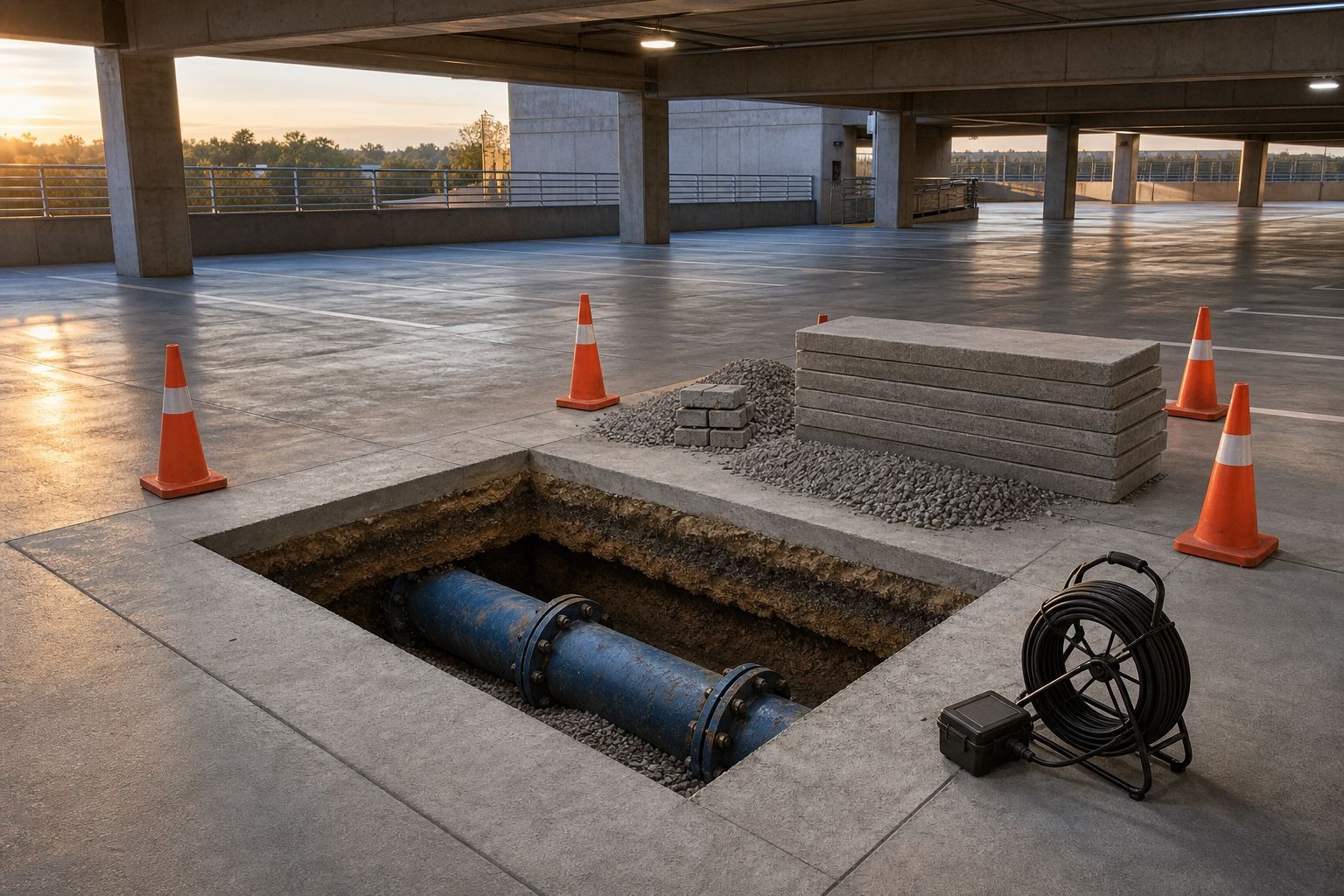
What does a facilities director at a regional hospital actually check before calling a contractor about a failing water main, and what happens to the firms that never bothered to put that proof online?
Most plumbing marketing answers a different question. It answers how to get more calls this week. That is not the buyer standing over a compromised 12-inch main under a parking structure, weighing shutdown costs against liability exposure. That buyer is running a different search, asking a different question, and judging a website by a different standard entirely.
Define the High-Stakes Water-Main Market
Routine plumbing demand is reactive and small in scale: a clogged line, a leaking fixture, a water heater on its way out. Commercial water main repair sits in a different category of consequence.
A failed main under a commercial parking lot, a hospital campus, or a manufacturing site does not just need a technician. It needs a firm that can document diagnosis, propose a defensible method, and coordinate around operations that cannot simply stop.
Three buyer environments drive this work:
- commercial property owners and facilities managers who need speed and disruption control
- utilities that need contractors capable of working within their operational standards
- municipal agencies that publish repair and replacement work as formal procurement
Each has its own risk tolerance and its own proof requirements.
The marketing job is not to widen the funnel for general plumbing leads. It is to connect three things a buyer needs to see together: what failure actually costs them, what repair capability the firm can demonstrate, and what documentation already exists to support a fast, informed decision.
A firm that cannot show all three online is competing on price alone, against companies willing to lose money to get the job.
Segment the Buyers by Operating Risk
Not every water-main buyer is shopping the same way, and treating them as one audience flattens the differences that actually decide who gets contacted. A commercial property manager facing an active leak is triaging against tenant impact and insurance exposure.
A utility engineer scoping a rehabilitation project is evaluating technical fit against an existing asset plan. A municipal buyer is often bound by a published notice with fixed terms. None of them read a homepage the same way.
| Buyer Group | Disruption at Stake | Proof Sought |
|---|---|---|
| Commercial property decision makers | Tenant disruption, liability, insurance claims | Response speed, restoration plan, past commercial work |
| Utility-facing opportunities | Service continuity across a wider system | Technical method fit, standards familiarity, crew capacity |
| Municipal procurement contexts | Public service continuity, budget accountability | Bonding, insurance, prior public-sector work |
| Emergency-oriented contacts | Immediate loss, active damage | Availability, clear next step, credibility signals |
Each group also expects a different message on arrival: commercial buyers want fast diagnosis and minimal downtime spelled out in writing, utility contacts want capability depth and a compliance record, municipal buyers want qualification readiness rather than persuasion, and emergency contacts want speed and reachability above everything else.
The evidence does not establish a single rule for how municipalities choose contractors. What it does show is that municipal buyers operate on published, structured terms rather than responsive persuasion, which changes what a firm needs ready before that notice ever appears.
Position Water-Main Repair Around the Failure Path
A commercial property manager finds standing water pooling near a loading dock at 6 a.m. By mid-morning, three tenants have called about pressure loss. The manager is now choosing between two contractors whose websites look almost identical. One shows a homepage with a phone number and a stock photo of a wrench.
The other shows a page walking through how a failing main gets diagnosed, which methods apply to which failure types, and what a restoration timeline actually looks like on a paved commercial lot.
The second firm gets the call, not because it advertised harder, but because it answered the question the manager was actually asking: can this crew tell me what is wrong and what happens next.
That is the question every page, proposal, and case study has to answer before a buyer initiates contact. Not “why choose us,” but “can you verify what you would do here, in my situation, with my constraints.”
A firm that cannot answer that in writing is asking the buyer to take the diagnosis on faith, and buyers with a failed main under an active commercial site are not in a faith-based mood.
Show the Diagnosis Before the Method
Diagnostic evidence has to precede method selection, both in the actual work and on the page describing it. Video pipe inspection and leak detection findings should be presented as the reason a given method was chosen, not as an afterthought below a list of services.
A buyer evaluating capability wants to see that method selection followed from evidence, not from whatever equipment happened to be on the truck.
Method claims need framing as capability proof, not blanket recommendation. Trenchless technology, pipe bursting, cured-in-place pipe, and traditional open-cut repair each fit different failure conditions, access constraints, and soil environments.
A firm describing pipe bursting can point to AWWA C622-26, which covers [pipe bursting standard for potable mains] ranging from 4 to 36 inches in diameter, giving proposals a defined technical reference rather than a marketing claim standing alone.
Document the Restoration Consequence
The after side of the scenario matters as much as the repair itself. Commercial buyers care about parking lot restoration, landscaping repair, and how long the site stays disrupted, often more than they care about the pipe technique used.
Case material that shows the site returned to normal use, not just the pipe repaired, closes the loop the buyer opened with the first call.
Build Local Search Paths for Repair Intent
Local visibility still matters even when a single water-main project draws a service radius far wider than a typical plumbing call. A commercial buyer searching at 2 a.m. for an active leak is not going to scroll past the first page of local results looking for a specialist three states away, whatever that specialist’s project portfolio looks like.
Presence close to the point of failure still decides who gets the first call, even on jobs eventually worth far more than a standard service visit.
What changes is what those local pages need to prove once someone lands on them. A generic “plumbing services” page cannot carry a water-main inquiry.
Several tasks here can be built independently of each other and in any order:
- Build dedicated pages for water main repair, sewer main repair, pipe replacement, and emergency response, each written to its own failure type and search intent.
- Align business-profile categories and service areas with the geography actually covered, rather than defaulting to whatever radius a template suggested.
- Route paid search only to matching pages, so a click on an emergency-repair ad lands on a page proving emergency capability, not a general contact form.
None of this claims a specific ranking outcome or performance level in any particular market. It sets the baseline a buyer needs before deciding the firm is worth a call.
Turn the Site Into Procurement-Ready Proof
A buyer evaluating water-main capability online is running an informal audit, whether they call it that or not.
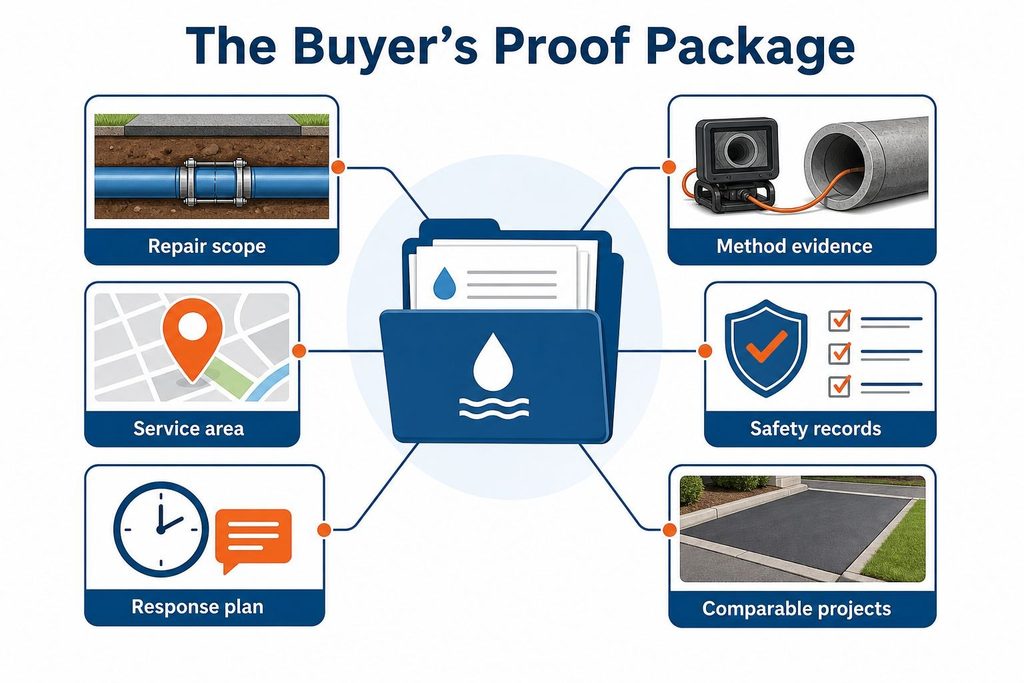
The minimum proof package includes:
- a clearly scoped description of water main repair capability
- a defined service geography
- an explained response and communication process
- evidence specific to whatever method the firm proposes, whether that is:
- trenchless rehabilitation
- pipe bursting
- CIPP
- open-cut replacement.
Safety and compliance documentation belongs in that package too, not buried in a PDF nobody reads. Referencing AWWA standards, OSHA regulations, EPA guidelines, and local municipal codes, where genuinely applicable, signals a firm that operates inside a documented framework rather than one improvising each job.
None of those references determine how any individual buyer will decide. They establish that the firm knows the framework its work sits inside, which is a different and more useful signal than a five-star review.
Commercial testimonials and case records round out the package. A buyer weighing operational risk wants evidence that a similar buyer, ideally in a similar facility type, has already trusted this firm with a similar failure.
Absent that, the site is asking for trust it has not yet earned.
Prepare Utility Contract Bidding Before Promotion
Utility contract bidding is not something advertising spend accelerates. It is a readiness workflow that has to exist before a notice is even published, and firms that treat it as a marketing channel usually discover the gap only after losing a bid they were technically capable of winning.
A published bid notice, like the water main replacement opportunity listed by [La Habra Heights water main bid], moves on its own published terms and timeline, not on responsiveness to outreach.
Separate Visibility From Qualification
Being findable online and being qualified to bid are two separate conditions, and conflating them costs firms opportunities they never even see. Qualification depends on registration status, current insurance and bonding, and whatever documentation a given agency requires before a bid is even considered.
A bid tied to substantial project value, such as the water-main tender publishing an earnest money deposit alongside its estimated cost, makes clear that qualification failures can eliminate a firm before technical merit is ever weighed.
Package Standards as Verifiable Proof
Compliance documentation has more weight when it is organized before it is needed, not assembled under deadline pressure. AWWA C651-23 sets out disinfection, sampling, and chlorine residual testing requirements after new-main installation or main-break repair.
A firm that already documents this process on every job has a reusable proof point ready for the next bid packet rather than a scramble to reconstruct it.
Several preparations belong in an ongoing routine rather than a one-time push:
- Monitor bid notices across the municipal and utility sources relevant to the firm’s service area, on a fixed schedule rather than an ad hoc check.
- Assign ownership for registration renewal, document collection, and submission tracking, so no single deadline depends on one person’s memory.
- Review insurance, bonding, and bid-security requirements for each notice individually, since terms vary by project value and issuing agency.
- Build reusable capability and project-proof records covering methods, crew certifications, and completed comparable work.
- Record submission deadlines and any question periods, since most public bids close on fixed dates with no allowance for late qualification.
Capture Credibility After Each Repair
Completed work that produces no reusable record is a wasted asset. A crew finishes a commercial water-main repair, the site is restored, the invoice goes out, and nothing about that job ever appears anywhere a future buyer might see it.
That gap shows up months later as a thin case-study page and a sales team with nothing new to point to.
A post-project capture routine closes that gap without inventing anything:
- Permitted photos of the failure and the completed restoration belong in a standard checklist.
- A short written account of scope and method chosen and notes on access or restoration constraints belong in a standard checklist.
- A record of how response and communication actually unfolded rounds out the file, done once, on every commercial job.
Client-approved testimonial language, requested while the relief of a resolved problem is still fresh, tends to be both more honest and easier to secure than a request sent weeks later.
That material then feeds three places at once: the local service pages needing current proof, the sales team’s follow-up conversations with similar prospects, and the next bid package needing a documented comparable project.
Set a Defensible Commercial Threshold
Cost and margin questions around water-main work do not have a clean published answer, and firms searching for a standard number to quote against are asking the wrong question. Scope, site access, and whether the job is emergency or planned all shift the cost structure before method is even chosen.
Method selected, restoration requirements, compliance work, and risk allocation between the firm and the buyer add further variables that have to be documented before a number gets attached to any of it.
Two jobs that look similar on the surface can carry very different cost structures once access constraints and restoration scope are actually compared. Profitability judgments follow from that same documentation, not from an industry benchmark applied blind.
A firm that has not scoped and recorded these variables is guessing at a price, not calculating one.
Market only the water-main work that the firm can prove it can scope, deliver, and document to the buyer’s required standard. Pulling one completed commercial water-main job from the last year and checking whether its failure diagnosis, method choice, and restoration outcome are documented anywhere a buyer could find them today is the test that matters here.
A firm that cannot produce that documentation on demand is not ready to market this work, no matter how much traffic it can buy.
About the Author