

The agency with the strongest pitch is often the weakest operator. That is not a cynical guess; it is a pattern that shows up whenever a buyer separates presentation quality from operational proof, and it holds because pitching and running campaigns draw on almost none of the same skills.
A polished deck, a confident account executive, and a case study slide with no methodology attached can sit in front of a buyer for an hour without a single verifiable fact changing hands. Meanwhile the agency that shows up with a messy screen share of an actual Google Ads account, mid-optimization, with negative keyword lists and call logs on screen, often looks less impressive and performs far better.
The gap between those two impressions is exactly what an evaluator has to close before a contract gets signed, not after.
Define the Decision Criteria Before Comparing Agencies
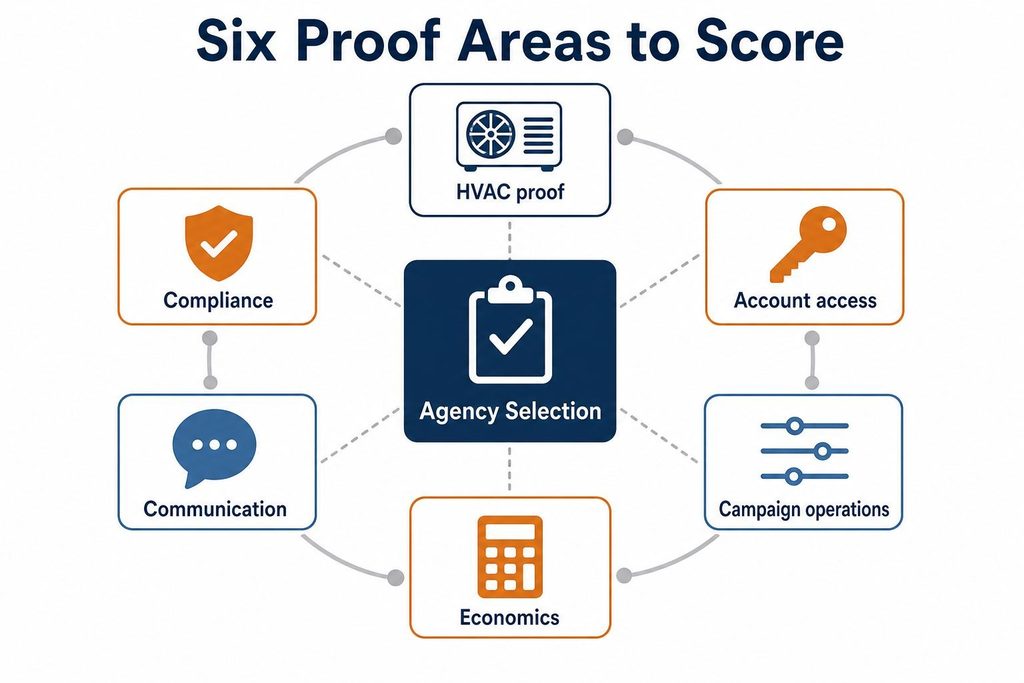
Selecting a paid search partner for a heating and cooling business is an evidence decision, not a search for the lowest management fee or the most convincing sales call. Treating it as the latter is how buyers end up locked into twelve-month contracts with agencies that never demonstrate they can find, qualify, or convert an HVAC lead at a defensible cost.
The evaluation holds up only if the criteria are kept separate from each other. HVAC relevance is not the same question as account control, and neither is the same as campaign operations or economics. Communication practices and compliance posture are separate again. Collapsing these into a single impression, “they seem good,” is how weak vendors survive scrutiny: a strong answer on one dimension gets allowed to cover for silence on another.
- HVAC relevance: has this agency demonstrably run heating and cooling accounts, not just home services in general
- Account control: who owns the Google Ads account and can the client see everything in it
- Campaign operations: what specific mechanics are being run, tested, and adjusted
- Economics: are fees, spend, and results reported separately or blended into one number
- Communication: what cadence, reporting, and escalation path exists
- Compliance: how the agency handles advertiser policy and claims substantiation
The same standard applies without adjustment whether the provider primarily serves California, Texas, or any other market; nothing in what follows should be read as evidence of regional differences in provider quality, since no such comparison is being made here.
Verify HVAC Proof Before Trusting Promises
Every agency claims relevant experience. Few can produce evidence that survives a direct question. The distinction that matters is between a documented outcome, tied to a named account or a specific reporting period, and a general claim of expertise that no client could verify if asked.
A case study is only proof if it specifies what was measured. “We grew leads by 40%” says nothing without knowing whether those were tracked, qualified leads or raw form fills, and over what baseline period. A reference client who will take a call and describe the relationship in their own words is worth more than three slides of screenshots. Portfolio evidence should show actual ad copy and landing pages built for HVAC service lines, not a generic template with a furnace photo dropped in.
| Proof Category | Acceptable Evidence | What to Verify | Warning Sign |
|---|---|---|---|
| HVAC case studies | Named account, defined metric, dated period | Whether “leads” means qualified leads or raw form fills | Percentage gains with no baseline stated |
| Client references | Current or recent HVAC client willing to speak | Whether the relationship is active or long since ended | Only written testimonials, no live contact offered |
| Portfolio evidence | Actual ad copy and landing pages built for HVAC | Service-line specificity, not generic templates | Same portfolio shown across unrelated trades |
| Qualified-lead definition | Written definition distinguishing lead types | Whether spam and wrong-number calls are excluded | No definition offered until after signing |
| Certified professionals | Named individuals with current certification | Whether certified staff actually work the account | Certification claimed at the agency level only |
| Account-management plan | Named contact, cadence, escalation path | Whether the plan matches account size | Vague promise of “dedicated support” |
A qualified-lead definition deserves particular attention, because it is where blended numbers hide. An agency that will not put in writing what counts as a lead before the contract is signed is unlikely to volunteer an unfavorable breakdown after.
Confirm Account Ownership and Service Delivery
Results only mean something if they can be audited independently of the agency reporting them, and that depends entirely on who holds the keys to the account. An agency that owns the Google Ads account under its own manager login, with no administrative access granted to the client, controls the narrative completely: it decides what gets shown and when. That arrangement is common, and it is also the single easiest way for a struggling account to hide behind confident language.
Ownership and access are governance questions, not performance guarantees. A client-owned account with full administrative visibility does not make the campaigns good; it makes them checkable. The following sequence covers what to confirm before service begins:
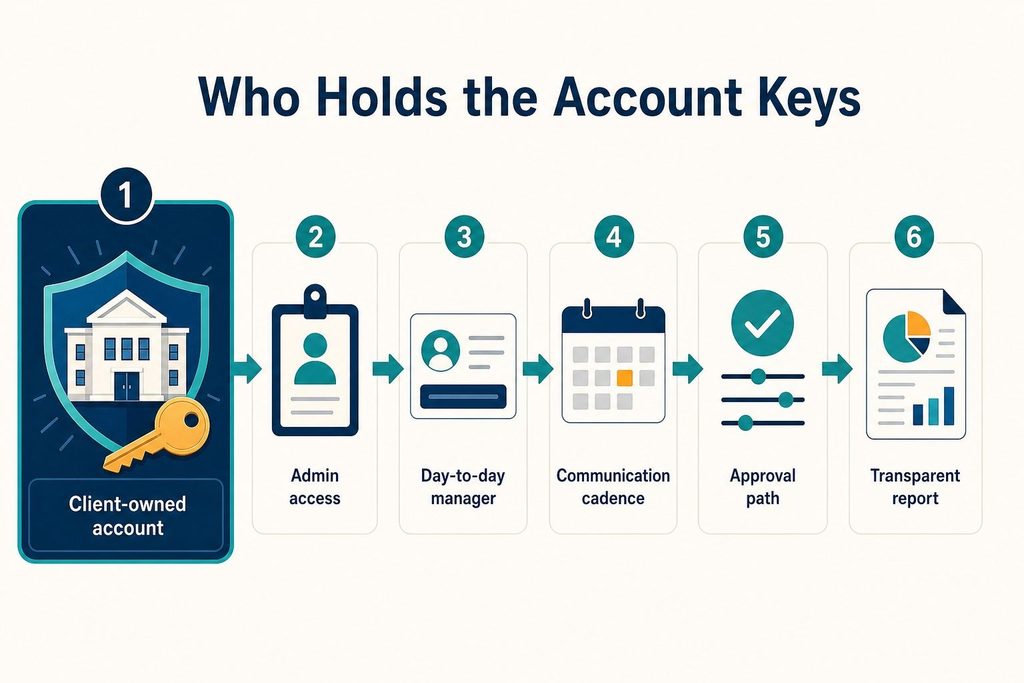
- Confirm the Google Ads account is owned under the client’s own manager account, not the agency’s.
- Request administrative access for at least one internal stakeholder, even if that person never logs in.
- Get the name of the person who will actually manage the account day to day, not just the account executive who sold it.
- Establish a communication cadence in writing: weekly, biweekly, or monthly, and what each call covers.
- Clarify the approval path for budget changes, new ad copy, and landing page edits.
- Specify what a performance report contains: spend, leads, cost per lead, and conversion source, at minimum.
None of this proves the campaigns will perform. It proves that if they do not, the client will be able to see why, and will not be locked out of their own advertising history if the relationship ends.
Inspect the Campaign System Behind the Proposal
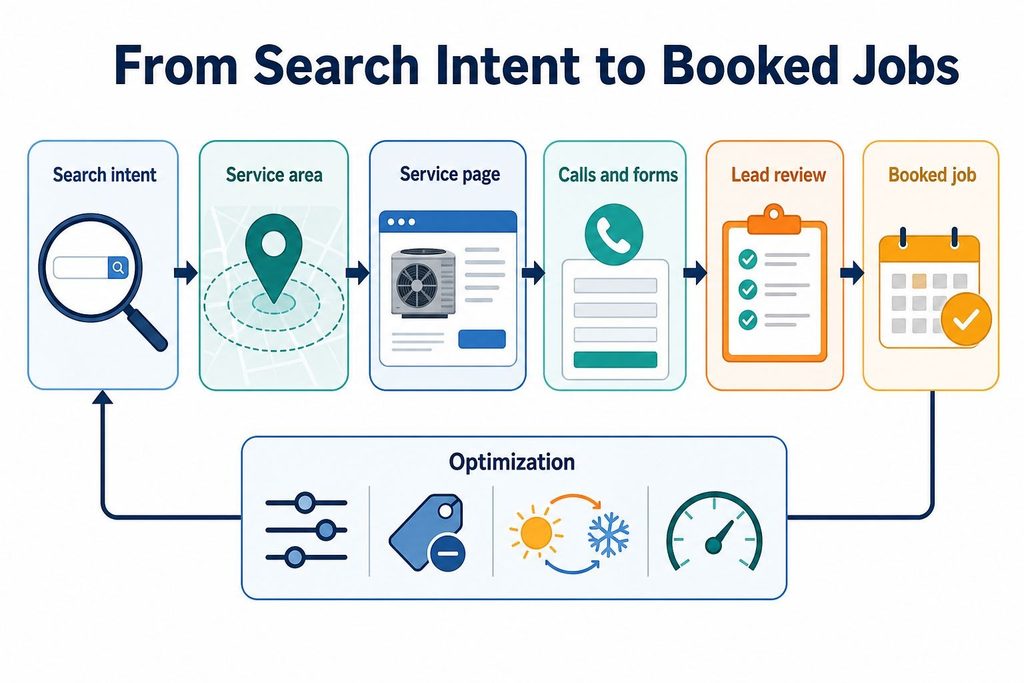
A proposal worth taking seriously describes a connected operating system, not a promise of more clicks. Clicks are the easiest metric in paid search to inflate and the least connected to booked jobs. An agency that leads with projected click volume, rather than a description of how leads get qualified and tracked, is selling traffic, not revenue.
How Keywords and Geography Get Targeted
The starting mechanics still have to be sound, even if they matter less on their own than most proposals suggest. Keyword research for an HVAC account should separate emergency repair terms from maintenance and installation terms, since the intent and the value per lead differ sharply between them.
Geographic targeting should match the actual service radius, not a broad metro area chosen because it produces a bigger impression count. An agency bidding on zip codes forty minutes outside the service area is optimizing for a bigger number, not a better lead.
How Conversions Get Tracked and Verified
Conversion tracking is where most weak accounts fail without anyone noticing until the numbers stop adding up. If a campaign cannot distinguish a form submission from a phone call, and cannot distinguish a real call from a wrong number or a spam call, every downstream number is unreliable.
Call tracking with recording or transcription, tied back to the specific campaign and keyword that generated it, is the baseline requirement, not an advanced feature. Landing pages should be built for the service being advertised, tested against alternatives, and loading fast enough not to lose mobile traffic before the page renders.
How Ongoing Optimization Actually Works
A more advanced evaluation benchmark, described in a 2026 HVAC and plumbing Google Ads guide, is whether the agency maintains trade-specific negative keyword lists and tracks leads through to booked jobs rather than stopping at the lead itself.
The same benchmark asks whether the agency balances Search Ads spend against Local Services Ads, and adjusts bidding for seasonality and technician capacity.
An account that runs the same way in January as it does in July, with no adjustment for heating season versus cooling season or for a contractor’s actual capacity to take new jobs, is not being managed; it is being left alone with a budget attached.
Separate Fees From Lead Economics
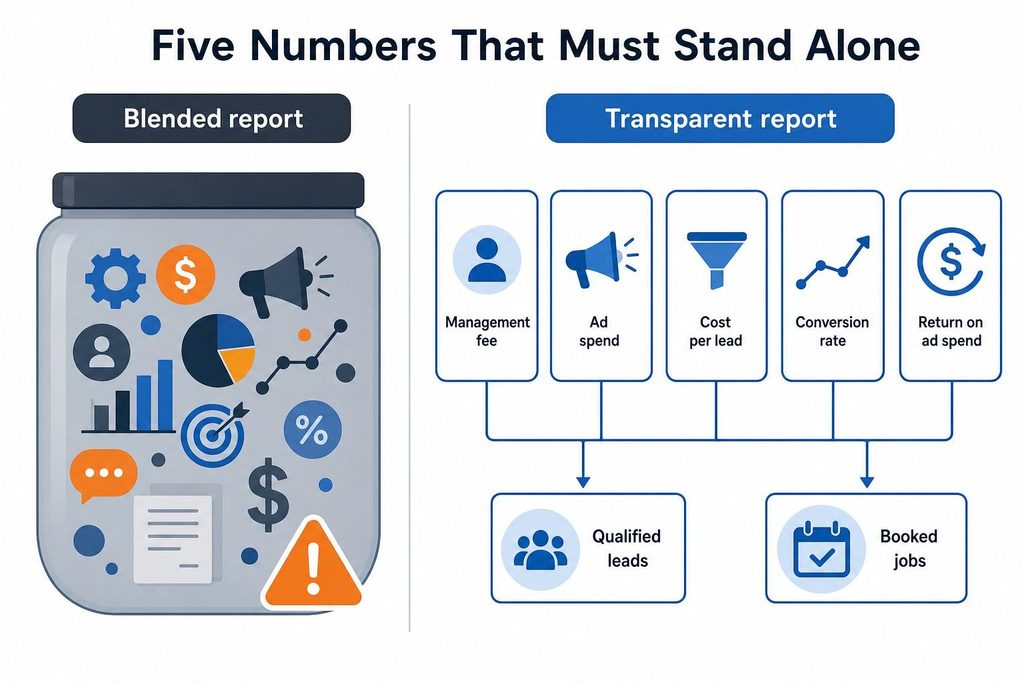
Proposals routinely blend financial terms in a way that makes the true cost of a lead difficult to see until months in. Separating them is not optional if the numbers are going to mean anything.
Five figures need to be reported independently, every reporting period, without exception:
- Management fee: the flat or percentage-based charge for running the account, separate from anything spent on ads
- Ad spend: the actual amount paid to Google for clicks and impressions
- Cost per lead: ad spend divided by tracked, qualified leads, not raw clicks or form fills
- Conversion rate: the share of clicks or visits that become tracked leads
- Return on ad spend: revenue attributable to booked jobs, measured against total spend including fees
An agency that reports a single blended “cost per lead” figure, with management fees folded into ad spend, has made it impossible to know whether a rising number reflects more expensive clicks or a growing service fee. Each figure should connect back to tracked leads and, where the contractor has the data, to jobs actually booked. No agency can responsibly promise a specific cost per lead or a guaranteed return before running the account, and one that does is pricing a guess as a commitment.
Test Optimization Discipline and Reporting
A campaign generating clicks is not the same thing as a campaign generating accountable demand, and the difference only shows up in the maintenance work most proposals gloss over.
The question worth asking is not “how many clicks did we get” but “what changed in the account this month, and why.”
A functioning account produces a visible trail:
- search-term reports reviewed for irrelevant queries
- negative keywords added in response
- bids and budgets adjusted against performance rather than left static
- call quality reviewed against the qualified-lead definition
- landing pages or ad copy tested against variants rather than launched once and forgotten
Conversion data should be validated periodically, not assumed accurate from day one, since tracking setups drift and break more often than either side likes to admit.
Clicks arriving with no accompanying calls is a common complaint, and it is worth treating as a diagnostic starting point rather than a verdict. It can mean broken conversion tracking, keyword targeting pulling in the wrong intent, or a landing page losing visitors before they act. An agency that responds to that complaint with a specific investigation, rather than a reassurance that “these things take time,” is demonstrating the discipline this section is trying to surface.
Check Policy Compliance and Local Advertising Controls
Treating compliance as legal fine print rather than an operational requirement tends to surface at the worst possible time, usually as a suspended account mid-season with no advertising running at all while the appeal works through review. Google’s advertiser policies cover claims substantiation, licensing disclosures, and prohibited practices, and heating and cooling advertisers face particular scrutiny around emergency service claims and pricing language.
A prospective partner should be able to explain, without hedging, how ad copy claims get reviewed before launch. They should also be able to describe how licensing and certification language is substantiated if used in ads, and what call-recording or consent practices are in place where call tracking is used.
Local advertising regulations vary by jurisdiction and by trade, and while no claim here extends to which specific rules apply in any one region, a partner unable to describe their general review process at all is a partner who has not built one.
Send a Focused Evidence Request
Every dimension covered so far converges on one practical action:
- HVAC relevance
- account control
- campaign mechanics
- separated economics
- compliance posture
request the same evidence from every agency under consideration, in writing, before any of them advance further.
Comparing polished pitches against each other produces a ranking of sales skill. Comparing responses to an identical evidence request produces a ranking of operational substance, and the gaps in a non-response are as informative as anything supplied.
A shortlisted hvac ppc company should be evaluated against exactly the same request as every competitor being considered, with no adjustment for how the conversation went. Where an agency answers three of five items well and goes vague on the other two, that gap deserves a follow-up question before a contract, not an assumption that the missing pieces are fine.
The Request Itself
Should stay narrow enough that a busy account manager can answer it directly rather than routing it to sales. Send this, unedited, to every agency still on the shortlist before the next call happens:
Send two HVAC-specific case studies with defined, verifiable metrics. Confirm Google Ads account ownership and provide a written account-management plan naming the person handling day-to-day work. Describe the conversion tracking, call tracking, and optimization process in specific terms. Report management fees, ad spend, cost per lead, conversion rate, and return on ad spend as five separate figures. State how advertiser policy compliance and claims substantiation are handled internally.
What comes back, and what does not, will do more of the deciding than the pitch ever could.
About the Author