
A residential water-treatment installer once ran a broad “water filter installation” campaign across an entire metro service area, no radius restriction, no landing page split by concern, one generic form asking only for name and phone number. Within a month the sales team had ninety-one inquiries and eleven consultations that led anywhere.
Most of the ninety-one lived outside the service radius, had already bought a filter elsewhere, or wanted a price quoted over the phone before anyone stepped on their property. The pattern repeats across the category because broad demand feels like success on a dashboard. It is not a technician failure, and it is not a marketing failure either. It is a measurement failure: counting inquiries where the business needed qualified consultations.
Define Qualified Water-Filtration Leads
A qualified water-filtration lead is not a form submission. It is a homeowner inquiry carrying enough signal that a technician can walk into a consultation already knowing roughly what problem exists, whether the property falls inside the service area, and whether the visit is likely to end in a proposal rather than a cancellation.
Volume is not the operational target here. A smaller number of exclusive, well-specified inquiries produces more closed business than a larger number of undifferentiated ones, and that distinction has to be built into how leads are captured, not corrected afterward in sales training.
Five signals separate a qualified inquiry from a raw one:
- confirmed service-area location
- a stated water concern (hardness, taste, odor, sediment, or a specific contaminant like lead)
- basic property context (well or municipal supply, single point of use or whole-home)
- the outcome the homeowner wants from a filtration system
- an explicit signal of readiness for a scheduled consultation rather than a price estimate by email
What Counts As A Qualification Signal
Location and readiness are binary and easy to check at intake. Concern and desired outcome are less binary; a homeowner writing “worried about lead in old pipes” carries a different urgency and a different likely system recommendation than one writing “water tastes metallic sometimes.” Both are legitimate, but they route differently, and the intake form has to capture enough language to make that distinction without asking the homeowner to self-diagnose.
Where Marketing Hands Off To Installation
The handoff point matters as much as the signals themselves. A lead that satisfies all five criteria still needs a documented handoff: what was collected, what wasn’t, and what the technician should confirm on first contact. Without that document, qualification work done at the form gets redone, badly, on the phone.
Calculate the Cost of Unqualified Inquiries
Broad advertising for water filtration systems attracts a wider audience than the service area, the price range, or the actual product line can serve, and the cost of that mismatch rarely shows up on the ad platform’s own dashboard. It shows up in technician calendars.
Five categories of hidden cost recur across campaigns that optimize for volume alone:
- Out-of-radius inquiries still get answered, because someone on staff has to open every submission to check.
- Unsupported contaminant claims, a homeowner certain their water is “toxic” without any test result, generate long calls that end nowhere, because the consultation cannot proceed past the point of an unverified concern.
- Duplicate or shared inquiries, common where a homeowner requests quotes from several installers in one sitting, get counted as fresh leads when they are really the same buyer contacted three times.
- Low-intent price shoppers ask for a number before a technician has seen the property, and no accurate number exists to give them.
- Wasted technician time spent driving to and running a consultation that was never going to close is the largest cost of all, because it is time that could have gone to a fit consultation instead.
The arithmetic is simple once the categories are named. Cost per lead, the number most campaigns report, divides ad spend by total form fills. Cost per qualified consultation divides the same spend by the number of inquiries that actually met the five signals above and converted to a scheduled visit.
The gap between those two numbers, on unfiltered campaigns, is frequently a multiple of three to five, not a rounding difference. Consumer financing options belong later in this sequence than most campaigns place them: introducing a financing conversation before fit and scope are established invites a homeowner to anchor on a payment figure for a system that hasn’t been specified yet, which produces exactly the kind of unqualified, disappointed inquiry the whole exercise is meant to prevent.
Publish Safe-Drinking-Water Education
Homeowners searching for information on drinking water safety are not, at that moment, shopping for a filtration system. They are trying to understand whether a problem exists. Meeting that search with education, rather than a sales page dressed as an article, is what earns the attention that later converts into a qualified consultation, and it does so without needing fear-based language to create urgency the facts don’t yet support.
One content cluster does this work. It should include:
- A core page explaining safe drinking water, written around what the term actually means, not around alarming contaminant lists.
- A supporting page on common water contaminants, organized by source (well versus municipal) rather than by severity.
- A page connecting water quality to family health considerations in plain, condition-based terms, avoiding guaranteed outcomes.
- A local water-testing services page that functions as the natural next step from any of the above.
What The Safe-Drinking-Water Page Has To Do
Its job is to answer the question honestly and then offer the one proportionate next step: a test, or a consultation, never a system recommendation before either exists.
Where Testing Content Draws Its Line
Testing pages describe what a test can confirm. They should not speculate about what a homeowner’s water probably contains.
Compare Lead-Removal Options Before Capture
Search behavior around lead specifically clusters into three recurring questions: which filters remove lead, what the best removal method is, and how a filtration system gets connected once purchased. Answering all three accurately, without turning the page into unsupported product endorsement, is where a lead-removal education page either earns trust or loses it in one paragraph.
The honest answer to all three starts with testing, not with a filter recommendation. The table below maps each homeowner question to the evidence that actually applies and the capture action that follows it.
| Homeowner Question | Evidence Or Decision Criterion | Appropriate Capture Action |
|---|---|---|
| Is lead actually in my water? | Testing is the only way to confirm presence; certified lab testing runs $15 to $100 per EPA guidance | Route to testing request, not system quote |
| Which filters remove lead? | Third-party certification to NSF/ANSI 53 and 42, reducing lead to 5 ppb or less, per the EPA point-of-use filter tool | Route to certified point-of-use or pitcher consultation |
| Is whole-home treatment warranted? | Depends on service line material, test results, and property scope, not on search-page advice alone | Route to whole-home consultation request |
| How does installation get connected? | Depends on local plumbing code and existing plumbing configuration | Route to installer scheduling, not DIY instructions |
The EPA’s own consumer tool exists specifically to help homeowners identify certified filters rather than guess, and pointing a homeowner toward that benchmark before naming a specific product keeps the page in an educational register instead of a promotional one. Hookup questions deserve the same restraint: what belongs on the page is a note that connection depends on local plumbing code and existing fixtures, and that a qualified installer confirms both during a scheduled visit, not a step-by-step diagram.
Capture Consultation-Ready Requests
An education page that ends without a next step wastes the attention it earned. But the next step has to match the concern that brought the homeowner there; a hardness complaint and a lead concern should not land on the same generic contact form asking only for a name and a callback time.
The call to action on each page should carry the language of that page’s concern into the form itself, so a homeowner arriving from a lead-removal page sees a form that asks about lead specifically rather than water quality in general terms.
What The On-Page Form Collects
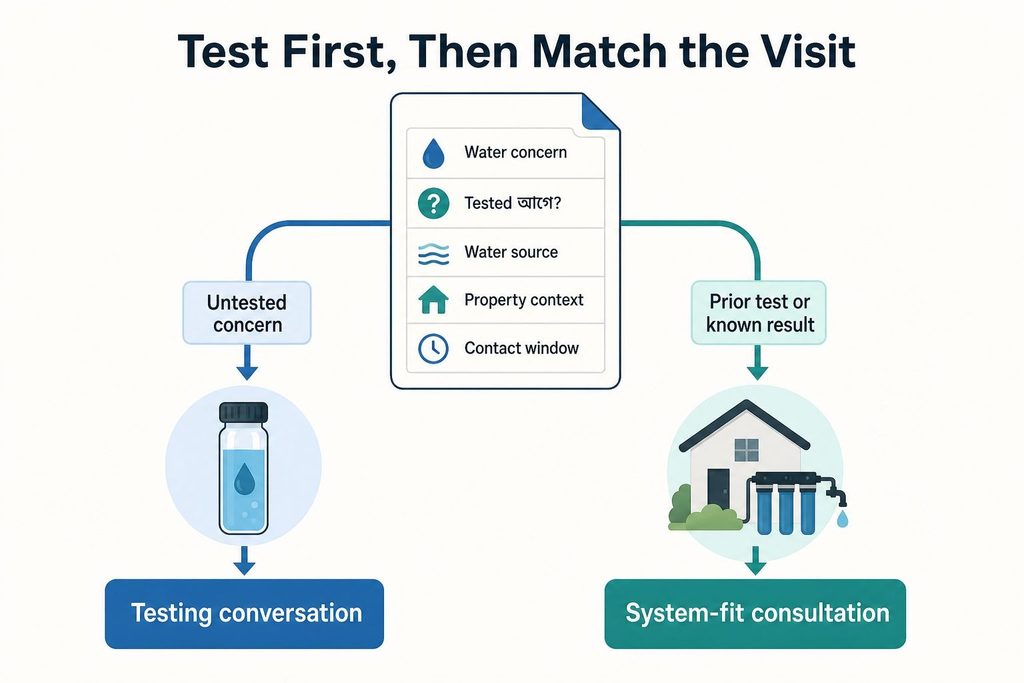
Beyond name and contact information, the form should capture whether water has been tested previously, basic property context (municipal or well, approximate age of plumbing), the specific concern that prompted the visit, and a preferred contact window. None of these fields need to be exhaustive; each one exists to shorten the first phone call, not replace it.
How Submissions Get Routed After Capture
A submission mentioning an untested concern routes toward a testing conversation first. A submission describing a known result, or a prior test, routes toward a system-fit consultation. Setting that branch at intake, rather than leaving every submission to land in one shared inbox, is what keeps a testing-stage inquiry from being pitched a whole-home system before anyone has confirmed there’s a problem to solve.
Build Local Visibility Through Google Business Profile and SEO
Being found and being qualified are two different achievements, and conflating them is a common way local visibility work fails to produce consultations. A homeowner can find a business through a well-optimized Google Business Profile and still submit an inquiry with none of the five qualification signals, because visibility work and qualification work solve different problems.
The sequence that connects the two:
- Align Google Business Profile categories and listed services with the specific systems and services actually installed, not a generic “plumbing” category that attracts the wrong search intent.
- Build service-focused pages that name the specific service (lead reduction consultation, whole-home filtration, water testing) rather than one page trying to rank for everything.
- Set every education page’s call to action to route into the qualification form described above, so organic and profile traffic enters the same qualified pipeline as paid traffic.
None of this depends on claims about how homeowners in any particular region search or behave. It depends on the profile and the pages accurately describing what the business does and connecting that description to the qualification path already built.
Verify Water-Quality Claims Before Follow-Up
Follow-up calls are where trust gets built or lost fastest, because a homeowner who feels oversold on a scary claim during the education stage will not schedule an installation, no matter how good the system is. Every follow-up should confirm three things before any system gets discussed: what testing, if any, has actually happened; whether the stated concern is a suspicion or a documented result; and what certification evidence applies to any filter under discussion.
What Testing Evidence Actually Confirms
A homeowner’s description of taste, color, or worry is a reason to test, not a substitute for a result. The EPA’s guidance on confirming lead in tap water is unambiguous that testing is the only way to confirm presence, at a typical certified-lab cost of fifteen to a hundred dollars, and that distinction should be stated plainly on the call rather than assumed.
What System-Fit Evidence Can And Cannot Say
A 2025 field study published in ACS ES&T Water found point-of-use faucet filters reduced lead below 5 µg/L in an unoccupied test home with a 28-meter lead service line, and below 1 µg/L in occupied homes with occasional elevated readings. That is a bounded result under specific study conditions, useful as evidence that certified point-of-use filtration can perform well, not as a guarantee for every property.
Installation-quality questions and local plumbing-code specifics belong to the installer conducting the in-home visit, documented and passed along rather than answered generically over the phone.
Complete the First Forty-Eight Hours
Three steps, in this order, because each one depends on the last being finished first.
- Pull one existing lead form today and check it against the five qualification signals. This comes first because every hour the form stays broad, new attention keeps getting misrouted into inquiries nobody can act on. Fix the routing logic at the same time: an untested concern should branch toward a testing conversation, and a known result should branch toward a system-fit consultation, so the fix holds the next time someone submits it.
- Once the form is corrected, publish or revise one safe-drinking-water page so its call to action points at that fixed form. This comes second, not first, because education traffic arriving before the form is fixed is demand spent on the exact mismatch the form was just built to prevent.
- Only after both are live should the lead-removal comparison and the Google Business Profile categories get reviewed for the same routing logic, because those channels feed the same form and inherit whatever state it’s in.
About the Author