
The restoration company that answers the phone first rarely wins because it advertised the most. It wins because it was findable in the ninety seconds a homeowner spent searching before calling anyone.
That single fact reorders the usual funding argument. Most operators treat marketing spend as a volume question: more leads, more jobs, more revenue. But the emergency water damage category does not work on volume logic. It works on sequence. Whoever the homeowner reaches first typically gets the job, and referral networks exist specifically to control that sequence in their own favor.
Water Damage Restoration Seo Protects The First Direct Call
The desired result is narrow and specific: a restoration company shows up, credibly, at the exact moment someone searches for water damage restoration or emergency water damage help in their own neighborhood, and that person calls the business directly instead of being routed somewhere else first.
That is not the same goal as generic traffic growth. A blog post that ranks for “how to prevent basement flooding” might bring visitors, but it rarely brings a homeowner standing in two inches of water at 11pm. The asset worth funding is narrower and more valuable: durable placement for the small set of terms that carry actual urgency, tied to a location, answered by a page built to convert a panicked visitor into a phone call within seconds.
This is what a properly scoped water damage restoration seo program is actually building. It is not brand awareness. It is not a content calendar for its own sake. It is a standing position in the exact moment a paying customer is deciding who to call, built so that position persists without a new spend decision every time it happens again.
What Makes This Asset Different From Ordinary Marketing Output
Three things separate this from a typical campaign line item:
- It is owned rather than rented. The ranking does not disappear the moment a subscription lapses, the way a paid placement does.
- It compounds. The same page that captures a call today keeps capturing calls next month without additional production cost.
- It is specific to intent. The target is not “more visitors” but the visitor who is already reaching for the phone.
A restoration company that ranks well for its core emergency terms is not competing on price or on relationship with an adjuster. It is competing on being the answer that already existed when the question was asked. That is a fundamentally different commercial position than being the fourth name someone tries after the first three did not pick up.
What Happens When A Company Is Invisible At The Search Moment
The symptom shows up as a soft decline in first-touch calls that nobody flags until someone asks why nearly every new job this quarter arrived through a claims adjuster rather than a direct search. The cause is rarely a bad crew or a weak reputation. It is that the company is absent, or unconvincing, at the exact local-search moment when the homeowner is deciding who to call.
That gap does not stay empty. Insurance referral networks fill it. So do national lead-generation platforms and, in plenty of markets, a competitor whose Google Business Profile is complete and whose service pages actually mention the neighborhood the homeowner lives in. None of those alternatives are inherently adversarial. They exist because someone has to answer the query, and if the local operator does not, someone else will.
The commercial consequence is dependence, and dependence has a price separate from any commission. A referral network controls the introduction, which means it can also control the terms of the relationship:
- the split,
- the volume,
- the standards a contractor must maintain to stay listed.
Owned visibility and rented access are not equivalent even when they produce a similar number of jobs in a given month.
A company that gets most of its emergency work through referral or lead-buying channels has effectively outsourced its most valuable asset, the first conversation with the homeowner, to whoever controls the routing.
This is not an argument that referral networks disappear once organic visibility improves. It is not a claim that ranking well guarantees the top position for every search either. Referral relationships remain useful, particularly for claims-driven work where the adjuster’s recommendation carries real weight regardless of who ranks where.
The point is narrower: a company invisible at the direct-search moment has no way to reduce its dependence on channels it does not control. Every dollar paid in referral fees or platform commissions is a dollar that a direct call would not have cost.
A No-Cost Search Audit Should Precede Any SEO Remedy
Before funding anything, the cheapest diagnostic available is simply looking. This costs staff time, not media spend, and it tells a payer which of three problems is actually present: invisibility, a conversion failure once found, or a tracking gap that hides calls already happening.
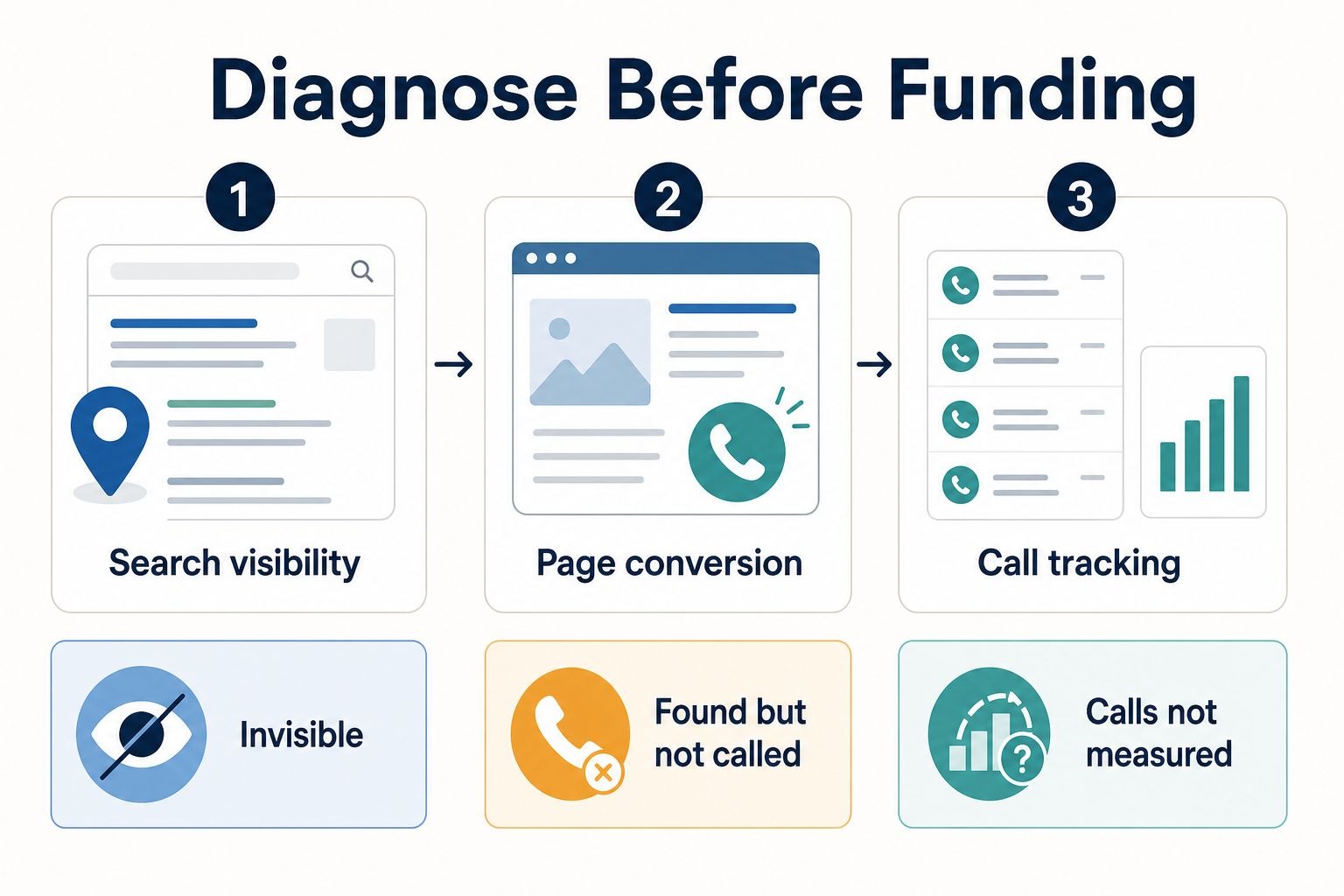
The audit runs in three steps, done in order because each one rules out or confirms a different failure point.
- Search the core terms a real homeowner would type, phrased plainly with a neighborhood or city attached, and note whether the company appears on the first page at all.
- Check whether business details are consistent and urgent, meaning the phone number, service area, and any 24/7 emergency language show up the same way across the listing, the website, and the map result.
- Pull missed-call and call-source records for the last several weeks to see whether calls are arriving and going unanswered, or not arriving in meaningful numbers to begin with.
The output of that audit determines everything downstream. A company invisible in step one has a visibility problem. A company visible but getting few calls has a conversion or trust problem on the page itself. A company that seems fine in both but shows no growth in tracked call volume may have an attribution problem masking real performance. Funding an SEO remedy before knowing which of those applies is how budget gets wasted on the wrong fix.
Accurate Local Signals Make Emergency Relevance Easier To Trust
If the audit shows an invisibility problem, the first remedy is not content or advertising. It is foundation work: getting the basic local signals accurate and consistent everywhere a search engine or a homeowner might check them.
That means:
- a complete and accurate local business profile,
- matching name, address, and phone information across every listing and page,
- verified service-area boundaries that reflect where crews actually respond,
- and 24/7 emergency language shown only where that commitment is real and staffed.
Local SEO practice treats these signals as prioritized inputs precisely because they are designed to establish geographic relevance for near-me and city-specific queries, the exact query type an emergency water event produces.
This work costs implementation and ongoing maintenance labor. That could mean internal staff time spent auditing and correcting listings on a recurring basis, or it could mean an agency scope built around local SEO specifically. There is no fixed price that applies universally, and no legitimate version of this work promises a ranking position in exchange for it.
What it buys instead is eligibility: a company with clean, consistent, verifiable local signals is positioned to be considered where a company with mismatched or outdated information may be filtered out before ranking is even evaluated. That distinction, eligibility versus guarantee, is the one a payer should hold onto before approving spend here.
Service Pages Convert High-Intent Searches Only When They Match The Emergency
Foundation work gets a company considered. Page-level work gets the visitor to actually call once they land. This is the second remedy, and it is distinct from the first: a set of pages built specifically around the water-damage and emergency-mitigation services the company performs, each one clearly separated so a search engine and a visitor can tell what is offered and where.
A homeowner arriving on a generic “restoration services” page, with no clear signal that the company serves their area or handles active water intrusion right now, is a conversion the company already paid to earn and then lost on the page itself. A page built around the actual emergency, with verifiable location relevance and a phone number visible without scrolling, converts that same visit at a meaningfully different rate.
The Two Costs That Sit Beneath This Remedy
This remedy costs:
- content,
- design, and
- technical implementation effort,
whether:
| built internally | or through an equivalent vendor scope |
|---|---|
| covering page structure, copy, and call-tracking setup. |
It also requires basic conversion tracking on every form and phone number so the spend can be measured against calls, not impressions.
What the terminology used internally to describe the work, mitigation versus restoration versus repair, does not change is the investment question itself: does the page get a caller to complete the call.
Trust Signals Reduce The Gap Between Search Visibility And Direct Booking
A homeowner discovering a company through search follows a fairly predictable path:
- an urgent search,
- a result that looks locally credible,
- a quick scan of reviews and business details to confirm it is real,
- then a call,
- and ideally a tracked outcome on the company’s side showing what happened next.
Referral-network routing skips most of that path entirely, since trust has already been established by the adjuster or platform making the introduction.
Closing that trust gap on the organic side means genuine customer reviews, backlinks from real local sources, and content that reflects the neighborhoods actually served, none of it fabricated or purchased. A mobile searcher checking whether a business is open right now, a behavior documented in restoration SEO research as common among the majority of mobile local searchers, is deciding in seconds whether this result looks credible enough to call.
The cost here is process and time:
- a consistent system for requesting reviews after completed jobs,
- effort spent on legitimate local relationships that produce real mentions or links,
- and governance to make sure none of it drifts into manufactured trust signals that damage credibility once discovered.
There is no shortcut that substitutes for this being genuinely earned.
Seo And Ppc Should Cover Different Gaps Rather Than Compete For One Budget
Preventing renewed dependence on referral networks does not mean abandoning every other channel. SEO and paid search solve different timing problems, and treating them as competitors for the same dollar misreads what each one does.
| Dimension | SEO | PPC |
|---|---|---|
| Speed to result | Slow, builds over months | Immediate, live once launched |
| Cost pattern | Production cost upfront, then compounds | Ongoing media spend plus management, every month |
| Value after spend stops | Ranking and page assets persist | No residual value once budget stops |
| Best use case | Durable position for core emergency terms | Coverage during slow growth or seasonal spikes |
Water damage restoration remains, per a 2025 industry benchmark reported by an industry publication, the most profitable service line for a majority of restoration operators, which is exactly the kind of margin that can justify paid placement during a slow organic-growth period or a known seasonal spike.
Neither channel replaces the operational basics. A company that wins the click but does not answer the phone, or that maintains no relationship with the adjusters who send steady claims-driven volume, loses the value either channel produced. The decision is not SEO or PPC. It is which gap each dollar is meant to close, and whether the company can actually staff the calls either one generates.
Direct-Lead Evidence Is The Only Proof That Justifies Renewal
Proof, in this decision, is not a ranking report. It is a small, specific set of numbers tracked over time:
- visibility for the core emergency terms in the company’s actual service area,
- the count of qualified direct calls those terms produce,
- how many of those calls convert to booked jobs,
- whether calls are answered promptly enough to matter,
- where each lead can be traced back to,
- and what share of total leads arrived without passing through a referral network or paid platform first.
That last figure is the one that answers the original question. A rising share of directly-sourced, tracked, booked work is the only evidence that justifies continuing to fund the work described above. A flat or declining share, even alongside improved rankings, means something upstream, likely conversion or answer-rate, is absorbing the gain before it reaches revenue.
That audit takes a few hours of staff time and produces the only evidence a payer needs before approving anything larger.
Fund the next phase only when the tracked share of direct, non-referral bookings is rising: that number, not the ranking report, is what decides whether the spend continues.
About the Author