
A plumbing company spent a season rebuilding its website into a polished brochure: a service list, a photo gallery, a paragraph about decades of family ownership. Calls did not follow.
The problem was not the copywriting. Someone searching “emergency drain repair near me” at eleven at night does not read a mission statement, and the map result that would have put the company in front of that search never carried the address, hours, or phone number a nearby homeowner needed to act on.
That gap between a general business site and a page built to answer an urgent, location-bound search is common because most plumbing marketing still gets planned like retail marketing.
It assumes a browsing customer with time to compare. Emergency plumbing searches do not work that way. They are decided in minutes, on a phone, often at the worst hour of someone’s week.
What the Local Search Foundation Actually Rewards
Treating a plumbing website as a general brochure is the single costliest habit in this trade’s marketing, because urgent nearby searches do not reward general content.
They reward three things at once: a location match, a service match, and a visible way to call immediately. A homeowner with a flooding basement is not evaluating brand positioning. They are scanning a map result, reading a star rating in half a second, and tapping the number that answers fastest.
That means visibility for emergency drain repair and emergency pipe repair is decided jointly by ranking and by what happens after the click, not by either factor alone.
A business can rank in the map pack and still lose the job if the mobile page takes too long to load, buries the phone number below a hero image, or routes the caller through a contact form.
Equally, a beautifully built site converts nothing if it never surfaces for the search in the first place.
Three signals decide whether that search becomes a booked job. Local intent match determines whether Google considers the listing and the page relevant to “near me” and city-plus-service phrasing at all.
Mobile experience determines whether the person who finds the result can act on it in the ten or fifteen seconds they are willing to spend before trying a competitor. Click-to-call placement determines whether that action takes one tap or four.
None of these operates in isolation, and none substitutes for the others.
A plumber who wants a coherent view of how these signals interact, rather than treating each as a separate task, is better served working from a structured framework such as local seo for plumbers than from a checklist assembled from unrelated tips.
The rest of what follows breaks that framework into sequence: what fails first, what to fix first, and what to measure once the fix is live.
Where Emergency-Call Leakage Actually Happens
Ranking exposure and conversion are two separate failures, and conflating them wastes effort on the wrong repair.
A business can be fully visible and still lose the caller, or invisible and never get the chance to lose them at all. Separating the two starts with a short diagnostic pass on where the funnel actually breaks.
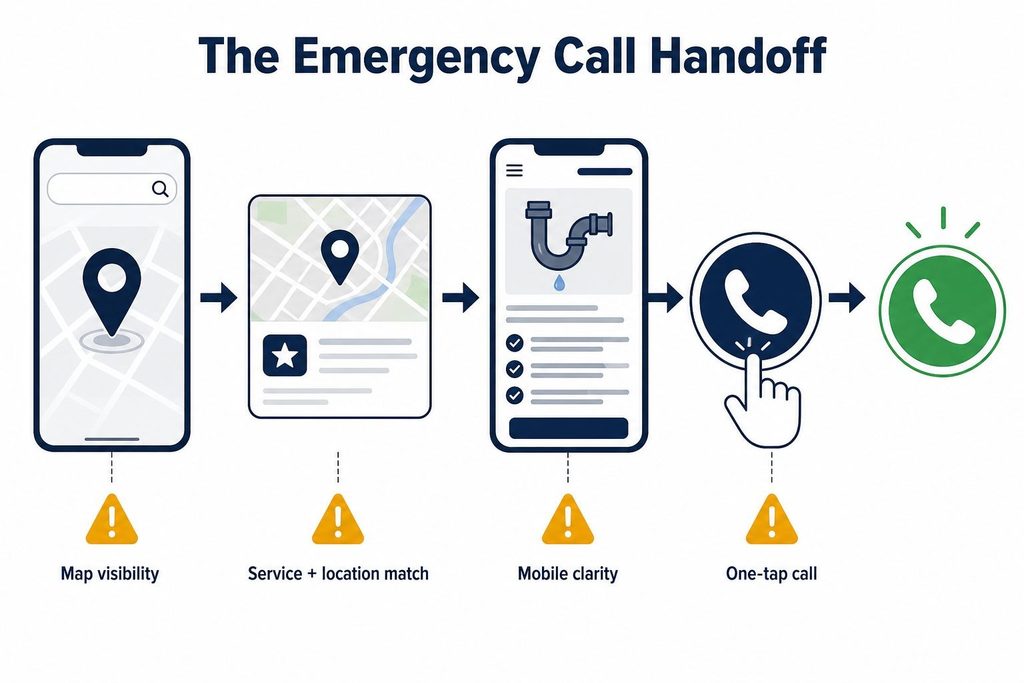
Four points account for nearly every lost emergency call:
- Absent or weak map result: the profile does not appear for “emergency drain repair” plus a nearby suburb, or it appears below three competitors with more complete listings.
- Mismatched service and location relevance: the page ranks for “plumber” generally but not for “burst pipe repair” in the specific area searched, so the click never happens on the term that matters.
- Slow or unclear mobile page: the page loads slowly on a phone, or the emergency service is not stated in the first screen a caller sees.
- Friction before calling: the number is present but small, unlinked, or placed under unrelated content, so the caller has to search for it under pressure.
An emergency drain repair search usually fails at the first point: the business shows up for general plumbing terms but not for the specific, higher-urgency phrase.
Emergency pipe repair failures more often show up at the fourth point, because pipe emergencies get described inconsistently (“burst pipe,” “leaking pipe,” “pipe burst repair”) and the page that ranks for one phrasing may not carry a clickable number at all on the version a mobile browser renders.
Which 20% of the Work Produces 80% of the Result
The decision that matters here is not whether local SEO deserves attention. It is which fraction of it deserves attention first, since most plumbing operators do not have the hours to run a full campaign across every channel at once.
A small set of actions accounts for most of the visible outcome:
- an accurate, fully completed Google Business Profile
- service and location pages that match real search phrasing
- credible and current reviews
- a call path that can be measured
Everything past that, blog content, broad brand awareness work, secondary directory listings, competes for time against those four and usually loses on return.
The practical case for continuing to invest here does not depend on a fixed payback period or an industry-wide guarantee.
It depends on the mechanics of how a map pack decides who to show. Those mechanics reward the businesses that keep their profile, their pages, and their reputation data current and consistent.
A plumbing operator choosing where to spend the next available hour of marketing time gets a clearer answer by asking which of these four levers is weakest right now, not by asking which tactic sounds most current.
The criteria worth applying before any other marketing spend are:
- does the map-pack result actually match the searches customers use
- is the business data behind it accurate
- do the local pages describe a real service in a real area
- are the reviews recent and credible
- can a call from any of this be counted
Why the Google Business Profile Comes First
Google Business Profile is the single surface most directly responsible for map-pack placement, which makes it the first repair on the list rather than one item among many.
A 2025 local-search ranking factors summary, reporting on Whitespark’s survey data as covered by ALM Corp, put Google Business Profile signals at roughly 32% of local pack ranking factors, ahead of any other individual category measured.
For a plumbing business trying to improve local SEO performance with limited hours, that is the highest weighted single lever available.
What a Compliant Profile Actually Requires
Verification has to be current, since an unverified or suspended profile does not compete in the map pack regardless of how strong the rest of the listing is.
The primary category should describe the core business precisely, plumber rather than a broader contractor category, because category mismatch is a common reason a business fails to surface for plumbing-specific searches.
Every service the business actually performs, including emergency drain repair and emergency pipe repair as distinct entries, belongs in the services section rather than folded into a single generic description.
Service area settings need to reflect where the business genuinely dispatches, not an aspirational radius, since an inflated area can dilute relevance for the neighborhoods that matter most.
Hours must include after-hours or 24/7 availability if that is accurate, and the phone number listed has to be the number that is actually answered, not a tracking number that later gets abandoned.
What Photos and Posts Actually Signal
A 2025 to 2026 guide on plumber local SEO ranking factors, published by Fast Launch Web, reports that businesses with more than 100 photos on their profile receive 520% more calls than those with fewer than ten.
That figure is directional rather than a guarantee tied to any specific business, but it points toward photo volume, especially job-site and before-and-after photos, as an underused signal.
Regular posts describing completed emergency jobs add freshness signals that a static profile lacks.
| Profile Element | Required Action | Emergency-Call Implication |
|---|---|---|
| Verification status | Confirm active and current | Unverified profiles do not appear in map results |
| Primary category | Set to an exact plumbing category | Wrong category filters the listing out of urgent searches |
| Services list | Add drain and pipe repair as distinct services | Determines which specific emergency terms surface the listing |
| Service area | Match actual dispatch range | Overreach dilutes ranking in the core area |
| Phone number | Match the number actually answered | Wrong or dead number loses the call after the click |
| Photos | Build past 100 where possible | Reported association with substantially higher call volume |
| Posts | Publish recent job updates | Signals an active, responsive business to both Google and callers |
Why Citation Consistency Confirms the Business Is Real
Consistent name, address, and phone data across every place a business is listed is what allows Google to treat a plumbing company as one confirmed entity rather than several uncertain ones.
That confirmation feeds directly into local relevance. A business whose phone number differs across three citation sources is not being penalized so much as diluted: the ranking system has less confidence in which record is correct.
An audit worth running quarterly covers:
- Name accuracy: identical legal or trading name across every listing, no abbreviations in one place and full words in another.
- Address formatting: the same suite number, street abbreviation, and punctuation everywhere it appears.
- Phone consistency: one number used across the website, the profile, and every citation, with no orphaned tracking numbers left active.
- Category and website alignment: the website URL and business category match what is claimed on the profile.
- Duplicate records: no second, unclaimed, or outdated profile competing against the primary one.
What Keeps Citation Data From Drifting
Citation cleanup is unglamorous, and it is also one of the few tasks with a clear finish line.
Once the primary data is correct on the website and the Google Business Profile, every other citation should be a mirror of that source rather than a separate decision.
What a Local-Intent Page Needs to Include
A page built for “emergency drain repair in [service area]” needs a title element and heading that state that combination directly.
Service copy should name the specific problem rather than generic plumbing language, and the page needs a visible local reference, a neighborhood, a landmark, a service radius, that a generic template will not have.
Mobile click-to-call placement belongs near the top of that page, not after several paragraphs of company history.
Local business schema markup, applied consistently, gives search engines a structured version of the same address, phone, and service data already confirmed elsewhere, reinforcing rather than contradicting it.
Secondary platforms such as:
- Angi
- Yelp
- HomeAdvisor
- Thumbtack
- Bing Places are worth maintaining for competitive presence and occasional referral traffic, but none of them substitutes for the profile and page work above.
Locally relevant partnerships, a supply house, a property manager, a local trade association, can add credible linking context without pretending to be the core strategy.
How a Finished Job Becomes Future Visibility
A completed emergency job is the beginning of an asset, not the end of a ticket.
The sequence that turns that job into future visibility runs from a timely review request, through a response that models professionalism for future searchers, into a data point about where and what kind of emergency work is actually happening, and finally into a page update that reflects that pattern.
Why Review Timing Changes the Response Quality
Requesting a review shortly after the job closes, while the relief of a solved emergency is still recent, produces a more detailed and more credible response than a request sent weeks later.
Responding to every review, positive or negative, demonstrates an active business to anyone scanning the profile before calling.
None of this guarantees a ranking position, and no specific review count should be treated as a target.
The more useful measure is whether reviews stay recent and whether they mention the actual services performed, since that language reinforces relevance for the same search terms.
What Makes a Service-Area Page Worth Publishing Separately
Distinct service-area pages earn their place when they describe a real difference, a different neighborhood’s typical plumbing issue, a different response radius, a specific emergency service performed there, rather than duplicating the same paragraph with the city name swapped.
Thin, duplicated location pages tend to undercut each other rather than expand reach.
A page for emergency pipe repair in one service area should read as though someone who works that area actually wrote it, referencing the kind of jobs completed there without inventing detail that was not part of the real job history.
How to Tell Visibility From Conversion
A repeatable measurement routine has to separate two questions that get conflated constantly: is the business visible, and is that visibility converting into qualified calls.
Checking map-pack presence for the priority service and location searches, done on a real mobile device rather than a desktop browser, answers the first question. It should be checked on a regular cadence, not once after a redesign and never again.
The second question needs its own tracking:
- profile actions such as calls and direction requests
- mobile click-to-call behavior on the website itself
- a way to separate emergency inquiries from routine maintenance or installation leads, since those have different values and different urgency
Comparing conversion quality, not raw traffic, is what actually tells a plumbing business whether the local SEO work is producing jobs rather than clicks.
What these measurements imply is straightforward even when the numbers are not: the weakest handoff in the chain, whether that is a map result that never appears, a page that loads slowly, or a phone number a caller has to hunt for, should be repaired before any adjacent signal gets attention.
Fixing a review strategy while the click-to-call button is broken corrects the wrong layer first.
Once the weakest point is repaired, the related profile, page, citation, or review signal gets reassessed against the same measurement, and the next weakest point becomes the next task.
What to Do in the Next 48 Hours
Every fix above assumes the profile beneath it actually works, so the order below starts there and follows the same dependency chain through to measurement.
- Verify the phone number and emergency-service listing on the Google Business Profile. Every other repair is wasted if the profile itself is unverified, miscategorized, or listing a number that does not connect, so this comes before anything else touches the page or the citations.
- Reconcile name, address, and phone data across the website and the highest-traffic citations. This depends on step one because the profile is the source of truth the citations need to mirror; doing it first would risk mirroring the wrong number.
- Pick one emergency service and location combination that currently underperforms, and improve that page first. Attempting every page at once spreads the same limited hours across low-priority pages before the highest-traffic one is fixed.
- Record a baseline: current map-pack position for the priority search, current call volume from the profile, and current mobile page load behavior. This has to happen last, once the profile and citation data are accurate, so the baseline reflects real conditions rather than a listing error that was there the entire time.
The smallest action to take today is the first one: verify the profile phone number and the emergency-service details it displays.
About the Author