
Doubling the number of leads a plumbing company generates online does not double the number of jobs that get dispatched, and treating those two numbers as the same thing is how marketing budgets get spent on growth that never shows up on the truck schedule.
The instinct is to buy more clicks, more calls, more form fills. But every one of those inputs has to pass through a chain of conversions, capacity limits, and job economics before it becomes a wrench turning at a customer’s address. A lead is a claim. A dispatched job is a fact.
The Number That Matters
What follows treats dispatch volume, not traffic, as the number the owner is actually paying to move.
Set the Dispatch-Volume Target Before Buying Traffic
Dispatch volume means completed, schedulable jobs, the ones that get a technician assigned, a time window confirmed, and a truck on the road. It is not website sessions, not form submissions, and not raw phone calls, all of which are upstream of the number that actually pays the bills.
Before any additional spend gets approved, four numbers need to be on the table:
- Booked calls per week, the current baseline before any new spend
- Close rate on those calls, not the number of calls alone
- Technician hours available to absorb new work without stretching existing jobs
- Job mix across emergency residential, scheduled maintenance, and commercial service that the spend is meant to grow
A target of, say, 40 additional dispatches a month only means something once it is checked against whether the business can staff 40 more jobs without blowing job quality or response time on the jobs it already has.
A doubled lead count against unchanged capacity does not produce doubled dispatches. It produces a longer hold queue, a lower close rate, and a marketing report that looks better than the schedule board does.
That mismatch is exactly why the funnel gets priced before it gets built.
Price the Gap Between Leads, Calls, and Booked Jobs
Every stage between a click and a dispatched job loses volume, and the loss is not uniform. Lead volume converts to calls at one rate, calls convert to bookings at another, and the acquisition cost per dispatched job compounds both losses on top of the original cost per lead. Skipping this arithmetic is how a channel that looks cheap on a cost-per-lead report turns out to be the most expensive way to fill the schedule.
| Scenario | Leads Generated | Call-to-Book Rate | Acquisition Cost per Dispatched Job |
|---|---|---|---|
| Low-cost, low-quality channel | 100 leads at $45 each | 20% booked | $2,250 per job |
| Mid-tier verified-lead channel | 100 leads at $90 each | 40% booked | $2,250 per job |
| Premium, high-intent channel | 100 leads at $150 each | 60% booked | $2,500 per job |
| Underperforming intake process | 100 leads at $90 each | 15% booked | $6,000 per job |
Use Benchmarks as Planning Inputs
Plumbing pay-per-click benchmarks commonly cited put cost per lead in a $45 to $150 range, and contractor marketing guidance generally recommends 8 to 12 percent of target revenue toward marketing overall. Neither figure is a guarantee.
Why Close Rate Changes the Math
They are planning inputs, and the table above shows why: a $45 lead with a 15 percent close rate is worse than a $150 lead with a 60 percent close rate, and the only way to know which one is happening is to track the close rate, not just the cost per click.
Competitive service categories or crowded bid environments may push realistic planning toward the upper end of the range, but that is a statement about auction pressure and lead scarcity, not a claim about any particular market.
Map the Full Funnel That Can Double Dispatch Volume
Doubling dispatch volume is achievable, but only by treating it as the output of a sequence, not the result of a single spend increase. The sequence has five steps, and each one has to hold before the next one is worth funding.
- Choose priority services and service areas. Pick the job types and geographies with enough margin and enough available technician capacity to absorb new volume, before spending a dollar on demand.
- Match demand capture to those services. Assign local SEO, Google Local Services Ads, or PPC to the specific service, not the business in general, so the traffic arriving is already relevant to what capacity exists to deliver.
- Route callers to service-specific conversion pages. A caller searching for a burst pipe should land somewhere that talks about burst pipes, not a homepage that talks about the company.
- Answer and book calls. No amount of upstream targeting compensates for a call that rings four times and goes to voicemail.
- Feed outcomes back into optimization. Every booked, lost, or deferred call becomes data that adjusts where the next dollar goes.
How Demand Capture Should Split
Local SEO earns visibility over time and does not respond to a budget increase the way paid channels do. Google Local Services Ads and PPC are switches that can be turned up or down against a specific service line, which makes them the tools for filling a capacity gap on a defined timeline rather than a general brand-building spend.
How Booking and Feedback Should Handoff
A booked call needs to land in a system that records the outcome (booked, lost, deferred) against the lead source that generated it, so the cost-per-lead numbers from the pricing table above can be checked against reality every week rather than assumed to be holding steady.
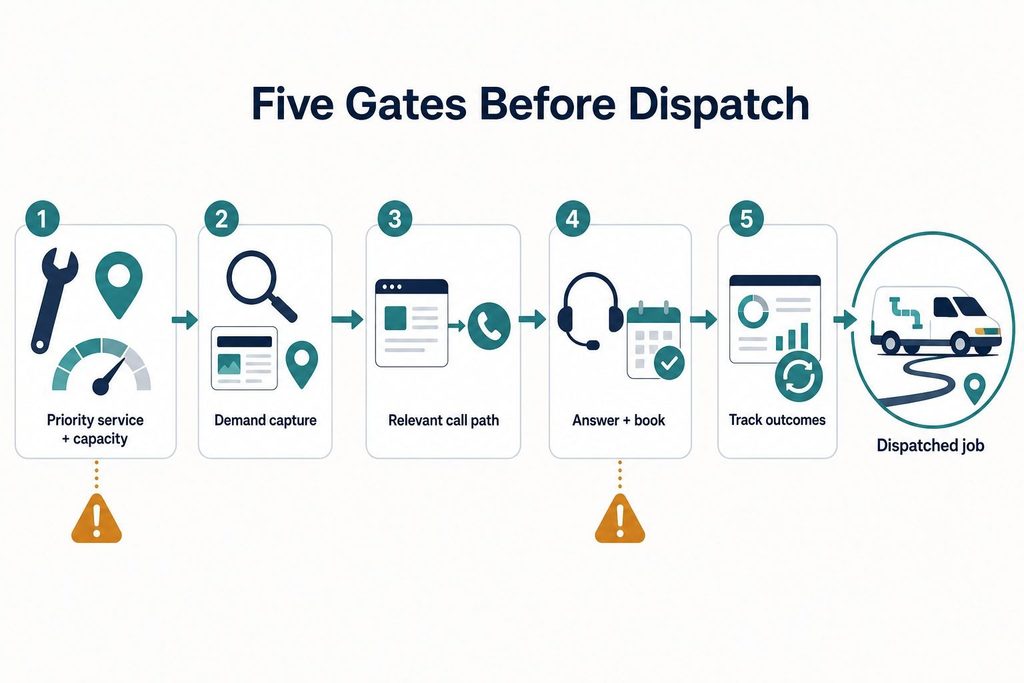
Dispatch volume, in this sequence, is never the target of any single tactic. It is the joint output of qualified demand arriving, that demand converting on the phone, and capacity existing to schedule the result. Funding step two without confirming step one, or step four without confirming step five, is the most common way a marketing budget increases while the schedule board stays flat.
Capture Urgent Demand Across Local Search and Paid Channels
Local SEO, Google Local Services Ads, and PPC do different jobs, and treating them as interchangeable ways to “get more leads” is where budgets get misallocated. Local SEO builds durable visibility in map results and organic search over months, and it costs nothing per click once it is ranking, which makes it the channel for persistent, low-marginal-cost discovery.
| Google Local Services Ads | PPC | | — | — | | are priced by verified lead rather than by click or impression, according to a 2026 plumbing marketing guide, which makes them a strong match for residential emergency demand where the customer wants a fast, trustworthy answer and the business wants to pay only for a real inquiry. | by contrast, offers granular control over: | | | – keywords
– geography
– scheduling |
which suits commercial plumbing campaigns where the buyer is comparing vendors deliberately rather than searching in a moment of crisis.
Residential and Commercial Intent
Residential emergency demand and commercial procurement intent do not behave the same way, and a channel mix built for one will underperform against the other. A homeowner with a flooding basement is not researching; a facilities manager evaluating a service contract is.
Businesses looking to combine these channels into one coordinated system, rather than running them as separate experiments, are effectively looking for internet marketing for plumbers that connects discovery, verified-lead capture, and controllable paid coverage under a single measurement framework.
None of that framework matters unless every channel is judged by the same four numbers: qualified calls generated, jobs booked from those calls, cost per lead, and return on ad spend. A channel that produces cheap leads but few bookings is not efficient. It is deferred cost.
Turn Service Pages and Calls Into Scheduled Work
Purchased demand leaks at the conversion layer more often than anywhere else in the funnel, and it leaks in ways that are easy to miss, because the traffic reports still look healthy while the booking numbers fall behind.
A service-and-location page that matches the search intent, a call button that is visible without scrolling, and job-intake fields that capture the details a dispatcher actually needs are not cosmetic details. They are the difference between a click that becomes a call and a click that bounces to a competitor’s number.
Call tracking has to be in place before any of this can be judged, because without it there is no way to know which page, which keyword, or which ad produced a given call.
Speed to answer matters just as much: a call that rings out or sits on hold past a caller’s patience converts at a fraction of the rate of one answered inside the first few rings, and that gap shows up directly in the call-to-book rate used in the pricing table earlier.
What Website Conversion Evidence Should Show
A service page for water heater repair should show water heater repair, not a general plumbing pitch with a phone number at the top. Relevance is what keeps the cost-per-lead numbers from PPC or Local Services Ads from being wasted on a page that fails to close the caller before they even dial.
How the Call-to-CRM Handoff Should Work
Every call needs a disposition: booked, lost, or deferred, logged against the source that generated it. A customer relationship management system that captures this consistently is what turns weekly close-rate numbers from a guess into a fact the owner can act on.
How Automated Follow-Up Supports the Handoff
Automated confirmations and reminder messages support this handoff by reducing no-shows and recovering deferred bookings, but any email or text communication used this way has to follow applicable tracking, cookie, and advertising-consent rules, since automated outreach touches the same privacy obligations as paid ad tracking does.
Without this layer, every dollar spent upstream is a guess about what happened after the phone rang.
Allocate Spend by Service Economics and Capacity
Budget decisions belong to the service line, not the marketing plan as a whole. A channel earns funding only where three conditions hold together:
- The margin on the resulting job supports the acquisition cost calculated earlier
- The technician capacity exists to deliver the job without displacing existing work
- The close rate on the calls it produces keeps acquisition cost under that margin
Where any one of those three fails, for instance a channel producing calls faster than the schedule can absorb them, or converting at a rate that pushes acquisition cost past the job’s margin, the right response is to restrict spend or pause the campaign, not to fund it in the hope that volume alone will fix the math.
Budget Benchmarks Are a Starting Point
Commonly cited guidance places total marketing investment at 8 to 12 percent of target revenue, with at least half of that typically directed toward digital advertising. That range is a starting point for planning a budget conversation, not a ceiling that applies uniformly to every plumbing business.
A company with thin margins on emergency residential work and full technician capacity should treat that percentage very differently from one running high-margin commercial contracts with spare crew hours. The ceiling that matters is the one calculated from contribution margin per dispatched job, not a percentage borrowed from a general benchmark.
Measure the Handoffs That Suppress Profitable Volume
Every stage between a marketing source and a paid invoice can be tracked, and each stage that breaks points to a different fix. The flow runs in order, and a break at any link explains why leads keep arriving while the schedule board does not fill:
- Source to lead: low volume here points to a visibility problem in local SEO, Local Services Ads coverage, or PPC bidding.
- Lead to answered call: a drop here usually means the landing page did not match what the searcher wanted, or the phone number was hard to find.
- Answered call to booked job: a break here is a call-handling problem, slow answer speed, weak intake questions, or an untrained booking process.
- Booked job to dispatched job: a gap here is a capacity problem, not a marketing one, technician hours cannot absorb the volume that was sold.
- Dispatched job to revenue and return on ad spend: the final check, confirming the job that got scheduled actually closed at the margin the budget assumed.
Reading this flow backward from a flat schedule board to a specific broken link is the fastest way to stop treating every stalled campaign as a lead-quality problem when it might be a booking, capacity, or follow-up problem instead.
Launch the First Forty-Eight-Hour Volume Test
The first move is not a bigger ad budget. It is establishing the baseline number the rest of the decision depends on, and that baseline comes first for a specific reason: without it, any increase in spend is a bet with no way to grade it afterward.
- Hour zero to hour eight, pull three numbers before touching a campaign: current qualified calls per week, current close rate, and current spare technician capacity in hours. This is the number the rest of the test is measured against, so it has to be pulled before anything else moves.
- Hour eight to hour twenty-four, pick one high-value service, the one with the best margin and the most available capacity, and confirm three things before spending anything new on it: the call path from its service page is visible and correct, call tracking is attached to that number, and the CRM has a field ready to record booked, lost, or deferred against that specific source.
This step comes before spend because data collected without it cannot be trusted later, it would have to be reconstructed after the fact. - Hour twenty-four to hour forty-eight, activate or refine the matching demand channel for that one service, whether that is a Local Services Ads campaign, a PPC campaign, or a local SEO adjustment. This comes last because a verified call path without a live demand channel produces nothing to measure, and spend without a verified call path produces leads nobody can trace. The order is what makes the test readable.
Beyond that window, let the channel run long enough to generate a real sample of calls rather than judging it after two or three, then review the booked-call evidence against the acquisition cost it produced, not the lead count. That comparison, made after the forty-eight-hour setup rather than during it, is what decides whether the channel earns a larger budget or gets paused.
About the Author