
What happens to a dispatch board on the first hot week of the year when a marketing campaign doubles inbound calls before anyone checked how many technicians were actually free to take them?
Most HVAC operators can answer that question after the fact, once the missed calls and overbooked slots have already cost them a week. Few can answer it before signing an agency agreement, which is the point where the answer actually matters.
The gap between those two moments is where marketing budgets get spent without producing bookable, profitable work.
What Must Be True Before an HVAC Company Partners With an Agency?
An agency conversation that starts with campaign ideas before anyone has looked at the schedule is starting in the wrong place. The order that holds up is the reverse: capacity first, demand second. Before any outreach begins, an operator needs a clear picture of current booked appointments, technician utilization rate across install and service crews, the actual service territory being covered, and how consistently calls get answered during peak hours versus after them.
That baseline is not paperwork. It is the only way to know what “more leads” would actually do to the business.
Field service scaling, defined plainly, is the ability to add demand without creating missed calls, longer lead times, or jobs that do not match the crew available to run them. It is not the same thing as lead generation.
A campaign can generate fifty new inquiries a week and still fail the business if only thirty of those calls get answered, twenty get scheduled, and twelve get completed by a technician within the skill and geography the job needs. Lead generation measures interest. Field service scaling measures whether that interest converts into paid, completed work without breaking the operation that has to deliver it.
The Three Questions That Decide Readiness
Three questions decide whether a company is ready to add paid demand at all:
- Is there measurable slack in technician utilization right now, or is the schedule already running near capacity on the crews that would take new bookings?
- Does install capacity differ meaningfully from service capacity, and would new campaigns need to target one and not the other?
- Are there known seasonal windows, a slow shoulder season or a summer surge, where added demand would land differently than it would today?
An operator who cannot answer those three plainly is not ready to evaluate agencies yet. The agency conversation should come after the capacity conversation, not instead of it.
Why Do More HVAC Leads Fail to Keep Technicians Productively Booked?
Local search for HVAC service is crowded, and most of that crowding shows up as raw inquiry volume rather than qualified, schedulable demand. A campaign built to win clicks in a competitive market will produce calls. Whether those calls turn into booked, completed jobs depends on operational steps that have nothing to do with the ad itself.
The break usually happens at one of six points:
- Unanswered calls: peak-season volume overwhelms the front desk and calls roll to voicemail.
- Slow follow-up: a web form or missed call sits unreturned for hours, long enough for the customer to book a competitor instead.
- Weak qualification: calls get booked without confirming service type, unit age, or urgency, and technicians arrive to jobs they cannot complete.
- Wrong service-area targeting: campaigns generate interest from addresses outside the actual dispatch radius.
- No open appointment slots: demand is generated for a week that is already full, so the lead goes cold waiting.
- No dispatch-to-marketing handoff: booking outcomes never make it back to the agency, so nothing about the campaign adjusts.
Each of those is a process failure, not a marketing failure, even though it shows up on a marketing report as a low conversion rate.
Which Questions Should Decide the Agency Shortlist?
Before any proposal gets reviewed, a short due-diligence pass should happen with every agency on the list, in the same sequence each time. Start by asking how the agency defines a qualified lead, in writing, not in general terms. An agency that answers with “someone who fills out the form” has not thought about qualification the way a dispatcher has to.
Ask next how calls get captured and tagged, because call tracking without disposition data (booked, not booked, wrong service area) is not useful for anything beyond volume counting.
Access matters as much as method. Ask whether the operator retains ownership of ad accounts, analytics, and call-tracking data, or whether the agency holds those behind its own login. Ask how the agency plans campaign pacing around capacity constraints and how it adjusts spend when a shoulder season slows bookings. Ask, specifically, how booked appointments (not just leads) get reported back on a recurring basis.
The Screen Most Shortlists Skip
One more screen belongs in this sequence and it is easy to skip: how much HVAC-specific operating knowledge the account team actually has, distinct from general local-service marketing experience.
An hvac marketing consultant who understands install-versus-service capacity, permit lead times, and seasonal load will ask different questions than a generalist will. A search for agencies with named Texas HVAC specialization will turn up general national guidance, not verified regional proof, and that gap should be treated as exactly that: a gap, not a disqualifier or a substitute for direct reference checks.
How Should the Partnership Agreement Turn Marketing Into Bookable Work?
A signed scope of work is not the same as an operating agreement, and the difference shows up the first time demand outpaces the schedule. Building an agreement that actually protects field capacity means working through a fixed sequence before the first campaign launches, not after.
- Start by setting service-area and capacity rules in writing: which zip codes, which job types, and what weekly booking ceiling the current crew can absorb without slippage.
- Next, select priority services and seasonal offers together, deciding jointly which weeks push maintenance agreements and which push emergency repair, rather than letting the agency choose alone.
- Assign approval authority for creative, offers, and budget changes to a single named person on each side, so campaign edits do not stall waiting on someone unavailable that week.
- Then establish lead-routing rules and a booking feedback loop: every lead tagged with its outcome, fed back to the agency on a set schedule, not on request.
- Set an optimization cadence, typically a recurring review of the same metrics rather than an ad-hoc call whenever volume looks off.
- Finally, document exit and data-access terms before the relationship starts, not when it ends.
Responsibility has to sit somewhere specific, not float between parties:
| Task | HVAC Operator | Agency Account Manager | Dispatcher/Booking Owner |
|---|---|---|---|
| Set weekly booking ceiling | Confirms crew capacity by service line | Builds pacing around the ceiling | Reports actual slots filled |
| Define qualified lead | Approves final definition | Drafts definition with operator | Flags mismatched bookings |
| Tag call outcomes | Reviews tagging accuracy | Provides tracking system | Enters disposition daily |
| Own compliance items | Names internal compliance contact | Confirms ad policy adherence | Not involved |
Every service description in that agreement should be produced by the team acting as the hvac marketing agency for the account, with the operator retaining sign-off on anything touching capacity or spend.
Compliance items need the same named-owner treatment as booking rules. Google Local Services Ads policies, CAN-SPAM Act requirements, TCP regulations on outbound calling and texting, and applicable data privacy regulations should each have a named owner in the agreement, not an assumption that “the agency handles that.”
Which Digital Services Belong in the First Operating Plan?
Not every channel belongs in the first ninety days, and sequencing matters more than breadth. Google Business Profile management and local SEO come first because they build durable visibility that keeps working during slow campaign months, and because a weak or inconsistent profile undermines every paid channel layered on top of it. Google Local Services Ads follow closely behind, since they capture service-intent calls from customers already searching to book, which tends to produce a higher share of schedulable work than broader paid search.
Paid search adds a layer of controllable demand once the operator can pace spend against open technician slots, but it should not be the starting channel for a company still stabilizing its call-answering process.
One 2026 HVAC marketing budget breakdown suggests companies under $500,000 in annual revenue keep monthly spend in the $1,000 to $3,000 range and concentrate it on Local Services Ads and Google Business Profile work before paid search enters the mix, which matches the sequencing above rather than contradicting it.
Website conversion paths (clear booking forms, visible phone numbers, service-specific landing pages) and call tracking round out the initial plan, since without them there is no way to attribute a booked job back to the channel that produced it. Commercial and mechanical campaigns, franchise-level coordination, qualified RFQ programs, referral incentives, and customer-experience marketing all matter over time, but they support a stable core rather than replace it.
How Should Seasonal Demand Change Agency Planning and Technician Scheduling?
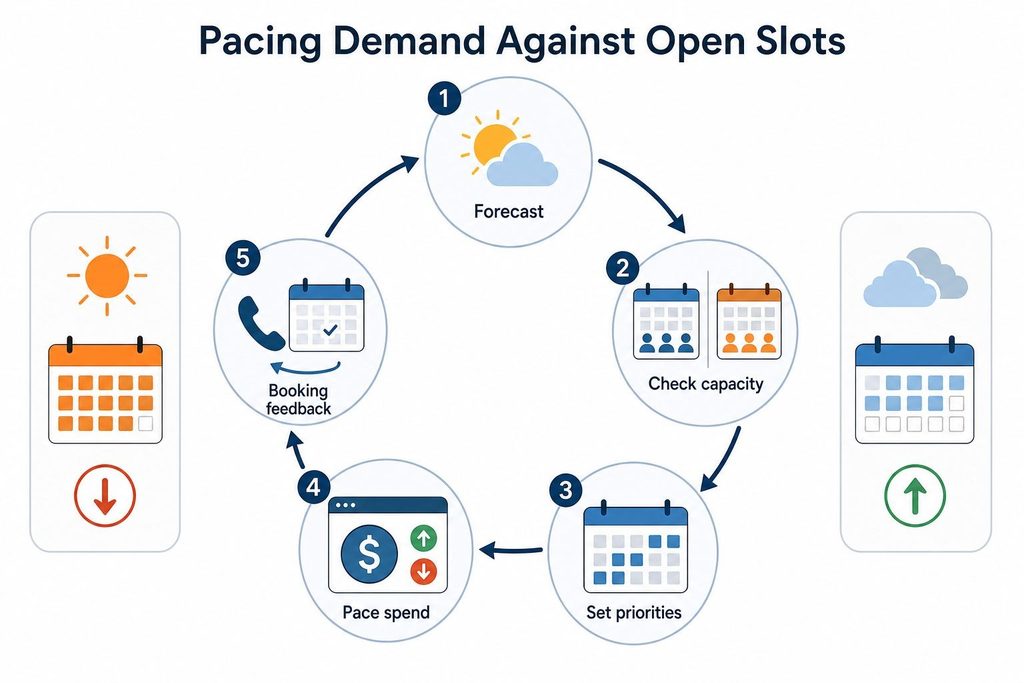
Weather does not move at the pace of a monthly marketing report, and campaigns built on a flat annual budget miss both the surge and the lull. A working seasonal process follows a fixed order every time demand is expected to shift.
- Confirm capacity by service line for the coming season, distinguishing install crews from service and maintenance crews.
- Set geographic and job-type priorities based on where crews are actually available, not where the market is largest.
- Pace ad spend against open appointment slots, increasing it when slots are plentiful and pulling it back as the schedule fills.
- Feed booking outcomes back to the agency on a running basis so pacing adjusts before, not after, a week overbooks.
- Redirect or reduce demand deliberately when capacity tightens, shifting spend toward maintenance agreements or off-peak services rather than simply generating more calls the team cannot take.
If summer heat is forecast two weeks out and utilization is already near ceiling, the correct move is to shift budget toward retaining existing maintenance customers rather than acquiring new emergency calls the schedule cannot absorb.
If a mild shoulder season leaves crews underbooked, the correct move is the opposite: increase local visibility spend and widen the service-area radius temporarily.
The same process, run in reverse depending on the season, is what keeps technician utilization steady instead of spiking and collapsing with the weather.
What Should the Agency Report to Prove Marketing Is Scaling Field Service?
A report full of impressions and click-through rates answers a different question than the one an operator needs answered. The scorecard that actually matters tracks cost per lead, lead quality against the agreed qualification standard, the conversion rate from lead to booked appointment, customer acquisition cost, and total booked appointments by service line.
Call tracking outcomes belong in the same report, broken down by disposition rather than volume alone: booked, not booked, out of area, wrong service. Where job value data is available, revenue context should sit next to acquisition cost so a rising cost per lead can be judged against whether the jobs it produces are worth more.
ROI reporting only means something if it separates channel performance from operational failure points. A drop in booked appointments could mean the campaign is targeting the wrong audience, or it could mean calls are going unanswered, or the schedule has no open slots, or close rates have slipped on qualified calls that were booked and then lost.
A report that blends all four into a single lead count leaves an evaluator guessing which problem to fix. A report that separates them turns the same numbers into a diagnosis.
Which Observable Signals Mean an HVAC Company Should Walk Away From an Agency?
Some signals are ambiguous and worth a conversation. Others are not, and continuing the relationship past them tends to cost more than starting the search over. None of the seven that follow require a gut feeling to detect. Each one is visible in a proposal, a contract draft, or a first month of reporting:
- Agency will not provide account or data access. End the evaluation. This is not something to negotiate later once spend has started.
- Cannot define a qualified lead in writing. Request a written definition before any spend goes out the door.
- Reports inquiries but never booked appointments. Require appointment-level reporting before renewal, not before signing.
- Cannot show call-tracking disposition data. Ask for disposition reporting, or replace the tracking vendor outright.
- No stated capacity or seasonal planning process. Ask for a written seasonal pacing plan before signing anything.
- Leaves compliance ownership undefined. Assign named owners for each regulation before launch, not after a complaint.
- Ties the operator’s data to inaccessible systems. Negotiate data portability terms or decline the contract entirely.
The next step is small enough to take today:
- send every agency on the shortlist the same written capacity-and-reporting checklist, covering:
- qualified-lead definition
- call-tracking disposition
- account access
- seasonal pacing
- and remove any firm that cannot answer it in writing before the first call.
About the Author