

A plumbing company signed a twelve-month contract after a proposal deck full of ranking screenshots and a promise to hit page one within ninety days. Six months in, the agency could point to three keywords that had moved up. It could not point to a single tracked call, a change in booked jobs, or a report tying any of that movement to revenue.
The contract had no exit before month twelve, and the website, built and hosted by the agency, was not something the plumbing company could take with it.
None of that was unusual. It is the default outcome of choosing a vendor on the promise of visibility rather than evidence of service calls, and it happens because ranking screenshots are easy to produce and easy for a buyer to check within thirty seconds.
Attribution, ownership terms, and cancellation clauses take longer to read and are correspondingly easier to skip.
What Must A Plumbing SEO Hire Be Evaluated Against?
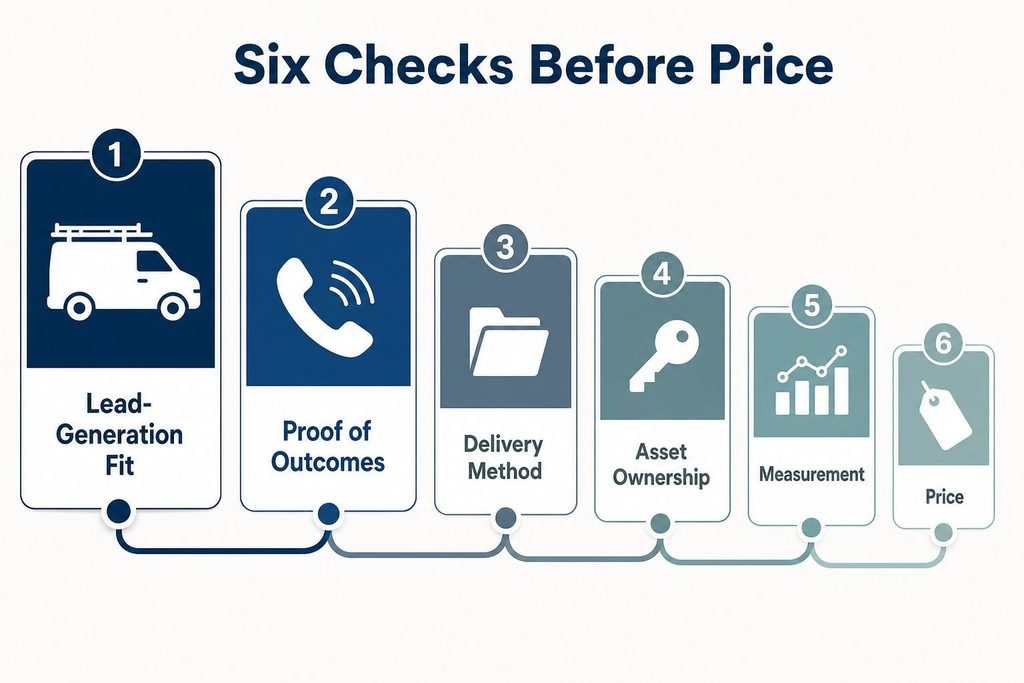
The decision splits into six checks, and they carry different weight depending on how much damage a failure does.
- Fit with the business’s actual lead-generation needs matters most, because an agency that optimizes for the wrong service or the wrong city produces work that never touches revenue.
- Proof of past outcomes comes next, since claims without documentation are unverifiable by definition.
- After that come three practical questions: how the work will actually be delivered, who owns the resulting assets and website, and how performance will be measured on an ongoing basis.
- Price comes last. It matters, but it should never be the first filter applied.
Search engine optimization, in this context, is the set of changes made to a website and its supporting listings so that it appears when someone searches for a plumbing service. Local SEO narrows that to searches tied to a location, which is how most plumbing demand actually behaves: a burst pipe does not send someone browsing nationally.
Google Business Profile visibility sits at the center of that local behavior. A business that shows up in the local map pack, the shortlist of three businesses Google surfaces above the standard results for a nearby search, is positioned where someone already looking for a plumber will see it first.
That positioning is only useful if it produces a call or a booking, which is why visibility and lead generation have to be evaluated as one connected outcome rather than two separate line items on a proposal.
A specialized plumber seo company should be judged against documented business outcomes: calls, booked jobs, tracked form submissions, not rankings alone.
Rankings are an intermediate signal. They are cheap to show and easy to misrepresent, and a proposal that leads with them instead of leads is telling the evaluator something about what it can and cannot prove.
Does The Agency Understand The Plumbing Calls The Business Needs?
Before comparing proposals, the business needs its own requirements written down, because a proposal cannot be judged as strong or weak without a fixed reference point. That reference point is a short internal checklist, not a marketing document, and it should exist before the first agency call.
- Priority services are documented: which services (drain cleaning, water heater repair, emergency response) matter most for revenue.
- Service areas are listed by name, not left as “the metro area.”
- Emergency availability is defined: which hours count as emergency, and whether that capacity actually exists to answer them.
- Target call types are specified: new customer inquiries, repeat service, or both.
- Lead-answering capacity is confirmed: can the business actually handle the call volume an effective campaign would generate?
- Conversion definition is agreed in advance: a call, a form, a booked job, or something else.
Keyword research should map directly onto that list. An agency doing this work correctly ties terms carrying emergency or repair intent to specific pages and specific tracked phone numbers, not to a generic list of “plumbing keywords.”
Claims that providers behave differently across California, Texas, or “near me” searches are not something the business can verify from a proposal, and should not be treated as a selection factor.
Which Provider Model Fits The Required Level Of Control?
Four kinds of vendor typically compete for this work, and they do not compete on equal terms. A specialized plumbing agency, a general digital marketing agency, an independent SEO consultant, and an in-house hire each trade off proof, breadth, and oversight differently.
The right answer depends on how much day-to-day control the business wants to retain.
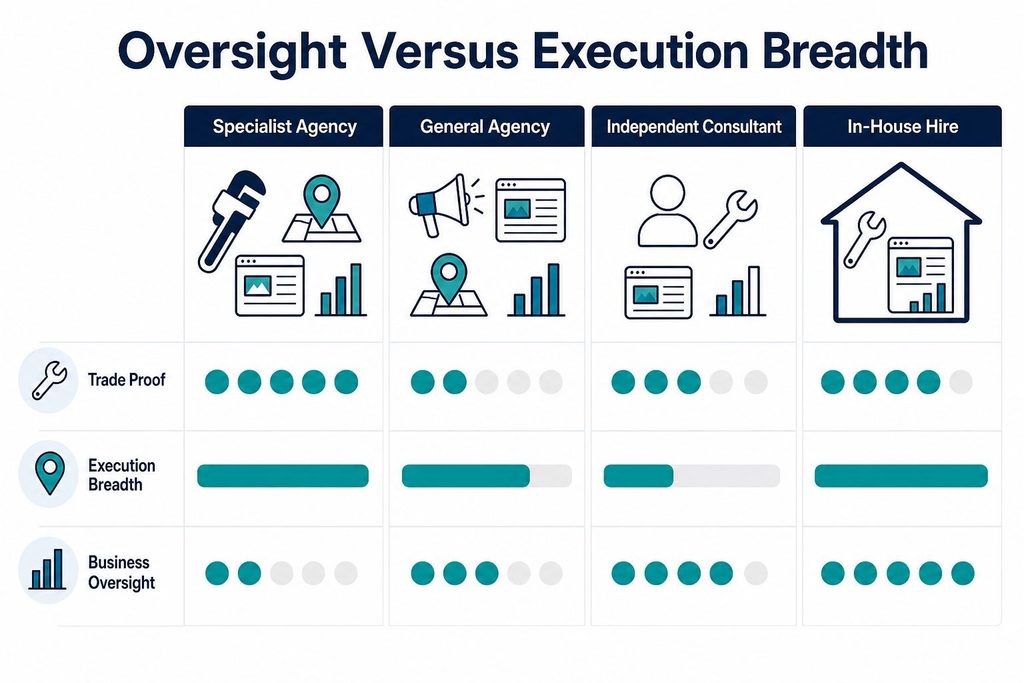
- A specialized plumbing agency usually has case studies from comparable trades available on request, and bundles local SEO, Google Business Profile work, service pages, and call tracking together, which keeps oversight low as long as reporting is written into the contract.
- A general digital marketing agency rarely has trade-specific proof to show, tends to run broad but shallow on plumbing-specific tactics, and needs more direction on trade terms than the specialists do.
- A freelance SEO consultant’s track record varies enough that it has to be verified individually, and the work itself is often narrow, technical SEO without the surrounding local and reputation work, which means the business ends up coordinating other vendors around it.
- An in-house hire builds proof over time rather than arriving with it, and the outcome depends entirely on one person’s skill set, with the business owning every result directly and carrying the highest oversight burden of the four.
The test is not which model sounds most professional. It is whether the model matches what the business actually needs: local execution across several channels, direct reporting access, and a level of operational control the business is prepared to exercise.
What Deliverables Must The Proposal Name And Show?
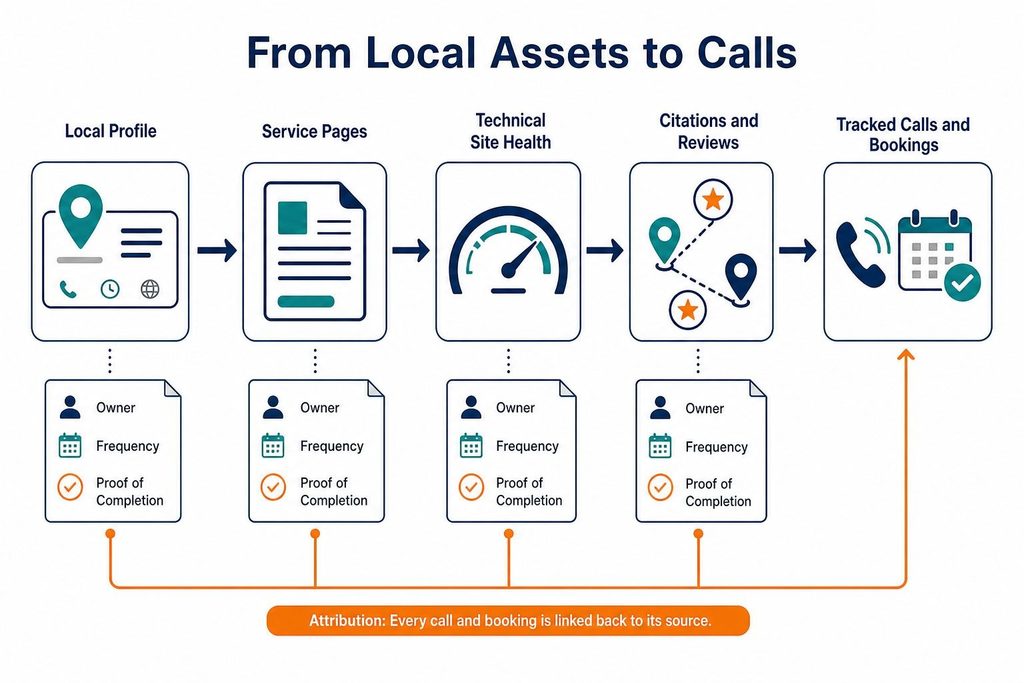
A proposal that survives scrutiny names each deliverable, assigns an owner to it, states how often it happens, and describes what evidence will confirm it was done.
A proposal that instead describes an overall philosophy or a proprietary methodology without naming a single deliverable has not actually proposed anything measurable.
Can It Produce Local Search Assets?
Google Business Profile work should include verification, full optimization, and ongoing maintenance: accurate hours, accurate service areas, and a steady stream of real-job photos rather than stock imagery.
A verified, well-maintained profile is what makes Local Map 3-Pack visibility possible for relevant searches, and that visibility is the asset the rest of the campaign is built to convert.
Service and city page content should be specific to the trade and the location, not templated language with the city name swapped in.
On-page optimization and technical SEO cover the structural work: page speed, mobile usability, and site architecture that lets Google understand what each page is for. Content marketing, where it appears, should serve those pages rather than exist as a separate blog with no connection to service intent.
Can It Show How Those Assets Produce Leads?
Link building should follow white hat methods consistent with Google Webmaster Guidelines: earned mentions, legitimate directory listings, and citations, not purchased links or link farms.
Reputation management, meaning active solicitation and response to reviews, and call tracking, meaning phone numbers unique to each channel so a call can be traced to its source, are what turn the assets above into evidence rather than assumption.
None of this should be described as proprietary and left unexplained. A method that cannot be described in plain terms cannot be audited, and an agency that leans on that language instead of documentation is asking to be trusted rather than verified.
Which Red Flags Should Stop The Evaluation?
Some proposal features are not weaknesses to weigh against strengths. They are stop signs, and the correct response to finding one is to end the evaluation of that vendor rather than negotiate around it.
- Guaranteed rankings: no legitimate agency controls Google’s algorithm; a guarantee here disqualifies the proposal outright.
- Black hat tactics or spammy link building: ask directly what link-building methods are used, and require a written answer.
- Unclear pricing: every deliverable should map to a line item; vague bundling is a warning, not a style choice.
- Website ownership retained by the agency: require written terms confirming the business owns the domain, hosting, and content outright.
- Opaque proprietary-process claims: ask for the process in plain language; an agency that cannot explain its own method cannot be audited.
- No case studies: request a plumbing-specific example with real, if anonymized, numbers.
- No client references: ask for a reference contact and confirm the agency has permission to share it.
- No verifiable results: if nothing can be shown that ties to booked work, treat the proposal as unproven regardless of how confident it sounds.
A 2026 hiring guide for plumbing SEO work names guaranteed rankings, retained website ownership, and the absence of a real case study as the clearest signals to walk away.
None of these are debatable on a case-by-case basis. They are disqualifying.
How Will Results Be Verified Before And After Signing?
Reporting access should be settled before a contract is signed, not negotiated afterward as a favor. The business should have its own login, or at minimum confirmed viewer access, to Google Analytics, Google Search Console, and whatever rank-tracking tool the agency uses.
A local SEO guide from a marketing agency recommends all three be used together specifically because they measure different things.
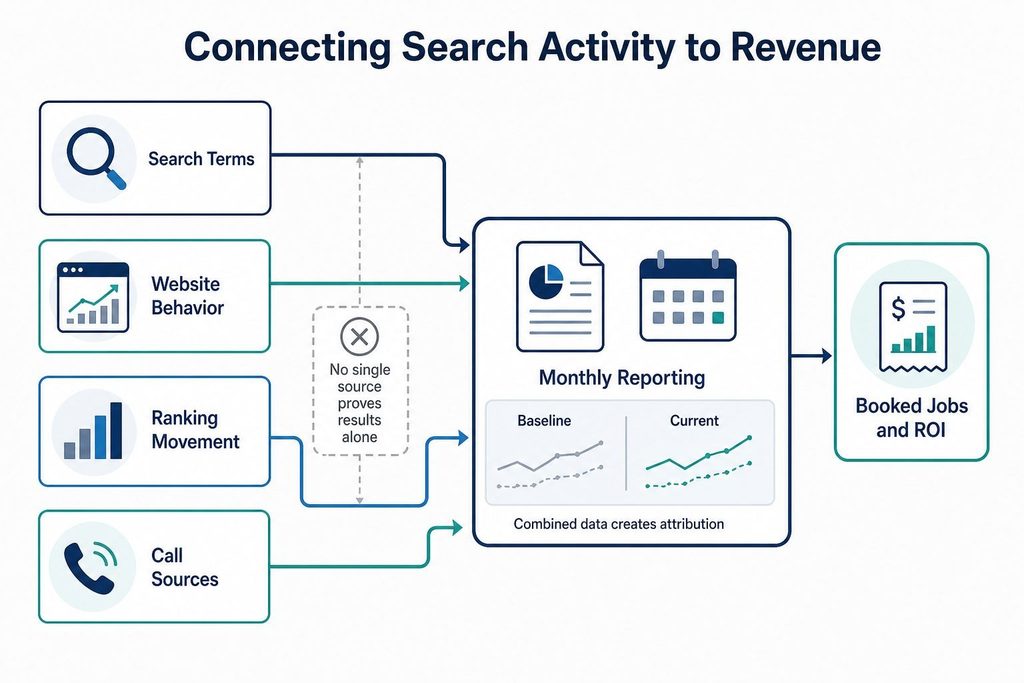
Search Console shows what search terms actually bring visitors, Analytics shows what those visitors do once they arrive, and rank tracking shows position movement over time. None of those three tools, on its own, proves a job got booked.
That is why monthly reporting needs to include together:
- organic traffic
- conversion rate
- keyword rankings
- local pack presence
- call volume
- cost per lead
- return on investment
with each metric shown against its baseline and its change over the reporting period.
Each figure should be tied to the page or source that produced it, not presented as a standalone number. A report showing rank movement with no call attribution is not a substitute for one showing booked work.
The cadence for delivering that report, monthly at minimum, should be written into the contract, not left as an informal understanding.
How Should Price, Terms, And Proof Be Tested Together?
The choice is not between the cheapest monthly retainer and an open-ended commitment with no defined ceiling. Both are the wrong framing, because price only means something once it is attached to a defined scope, and a defined scope only means something once it can be measured against results.
A written pricing model should state exactly what is included, what is excluded, the minimum contract term, and the terms for renewal and cancellation.
It should also state, in writing, who owns the website and the associated accounts if the relationship ends, since that question is far cheaper to settle before signing than after.
The proposal should explain, in plain terms, how spend will be related to cost per lead and return on investment once reporting begins, even if it cannot promise a specific number in advance.
Case studies and references deserve the same scrutiny as pricing. A case study from a comparable plumbing service, over a comparable timeframe, with a stated methodology and a measurable outcome, is evidence.
A general testimonial with no numbers is not. The two should never be presented, or accepted, as equivalent.
What Should Be Sent To The Finalists Today?
Only finalists that can document scope, confirm compliant methods, put ownership terms in writing, produce comparable case studies, offer real reporting access, and state their full pricing should move forward.
Any proposal that fails one of the checks above should be set aside rather than carried forward on the assumption that it can be fixed in negotiation. Ownership terms and cancellation clauses in particular tend to get worse, not better, once a business has already committed time to a vendor relationship.
The single next step is sending each remaining finalist the same short request, so the answers can be compared side by side rather than interpreted from a sales deck.
Please send: two plumbing case studies with real metrics and client reference contacts; the specific local deliverables proposed for our service areas; a written statement of link-building methods and website and account ownership terms; a sample monthly report showing traffic, rankings, local pack presence, calls, and cost per lead; and complete pricing with contract length, exclusions, and cancellation terms.
That request costs nothing to send and takes most agencies under a week to answer in full.
About the Author