
More marketing activity produces fewer profitable jobs, not more, when it is not tied to the specific work a restoration crew can actually staff, price, and collect on. That sounds backward for an industry built on urgent demand, where the phone ringing looks like success on its own. It is not.
A restoration operator can generate fifty inbound calls in a month and still lose money on the marketing that produced them, if half of those calls are small carpet-drying jobs booked at a discount to beat a competitor’s quote. The point of a lead system is not attention. It is the routing of urgent demand toward the jobs that pay for the crew, the equipment, and the certification behind the work.
What follows treats every channel, every message, and every referral relationship as accountable to that standard.
Define the Jobs the Marketing System Must Win
Water damage restoration marketing is not a set of ads, a website, and a social calendar running in parallel. It is the system that connects incoming demand to response capacity, screens that demand for job fit, and follows up until the work is either booked or logged as lost.
Framed any other way, marketing becomes a cost center with no defined return, and that is the condition most restoration companies are already operating under without naming it.
The Jobs Worth Winning Are Not Identical
Emergency water extraction calls for a crew on site within hours, equipment mobilized immediately, and a message built entirely around response time. Mold remediation work moves at a different pace: the property owner has often lived with a known problem for weeks, the sale is closer to a home-improvement decision, and the proof required leans on process and standards rather than speed.
Flood recovery, particularly at scale, brings structural drying, extended timelines, and frequently an insurance claim running in parallel with the physical work. Residential and commercial decision paths diverge just as sharply.
A homeowner is deciding alone, under stress, usually comparing price and reassurance. A facilities manager or property management contact is often working from a vendor list, a certificate of insurance requirement, and an approval chain that has nothing to do with how frightened anyone is about the water on the floor.
Two structural facts should anchor every channel decision that follows:
- Job size and scope, not lead volume, determine whether a channel is worth funding.
- Response feasibility, meaning whether the crew can actually reach the job in the promised window, is a qualification filter before price ever enters the conversation.
Restoration companies that get this sequencing right treat their marketing operation the same way they treat a drying job: define the target condition before spending resources chasing it.
Establish the Local Proof That Converts Urgent Searches
Someone searching for restoration help at 11pm with water coming through a ceiling is not browsing. They are trying to decide, in minutes, whether a company can be trusted with a fast-moving problem inside their home or business.
Every piece of online presence that company controls is either reducing that risk or adding to it, and there is no neutral middle setting.
A property owner in that position is reading fast and discarding fast. A profile with no reviews, a site with no service-specific page, or a phone number that goes to voicemail all read as the same signal: unreliable. The proof has to be visible before the call is made, not explained after it.
Several Elements of a Water Damage Restoration Marketing Presence Need to Be in Place and Checked on a Schedule, Not Built Once and Forgotten
What the Profile and Pages Need to Show
- Google Business Profile completeness: current hours, service categories, service area, photos of actual crews and equipment, and a response to every review, not just the positive ones.
- Local SEO and broader search engine optimization: pages that target the specific service, not a single generic “restoration services” page trying to rank for everything.
- Service-specific landing pages: separate pages for water extraction, mold remediation, and flood recovery, each answering the questions specific to that job type.
- Review collection and client testimonials: a running process, not a one-time push, with recent dates that signal the business is still active and responsive.
- Emergency-response expectations: stated response windows that the operation can actually meet, published where an anxious reader will see them first.
What Compliance Language Must Not Claim
Any reference to mold work or safety practice should describe what the crew actually does, aligned with EPA mold remediation guidance, IICRC standards, and OSHA safety standards, without implying a certification, endorsement, or compliance status that has not been documented.
A reported 2026 industry survey found that 57% of restoration companies named Google Business Profile as their top lead source, which is consistent with how much weight an anxious searcher places on what shows up before they ever reach a website.
Choose Channels by Lead Quality Rather Than Reach
Buying visibility is easy. Knowing which channel produced the roof leak that turned into a $40,000 flood recovery job, versus which one produced a $300 carpet-drying call that barely covered the technician’s time, is the harder and more consequential problem.
Without that distinction, a marketing budget gets allocated by volume of leads rather than value of jobs, and the channel that feels busiest is not always the channel that is profitable.
The six channels central to a restoration lead system behave differently enough that treating them as interchangeable “marketing spend” is a mistake in itself.
| Channel | Lead Intent | Suitable Job / Message | Measurement Focus |
|---|---|---|---|
| Google Business Profile & local SEO | High, often emergency | All service types; response-time proof | Cost per lead, review volume, call tracking |
| Organic search engine optimization | High, research-stage | Mold remediation, flood recovery detail pages | Long-term cost per lead, conversion rate |
| Google Ads (PPC / LSA) | Very high, immediate | Emergency water extraction | Click cost, booked-job rate, ROI |
| Social media | Low to moderate | Trust-building, not first contact | Engagement, remarketing audience size |
| Insurance agent marketing | High, referred | Flood recovery, larger commercial claims | Referral volume, closed-job value |
| Referral partnerships | High, pre-qualified | Repeat commercial, plumber/agent referred | Source-to-close rate, repeat rate |
Cost per lead means little without conversion rate sitting next to it, and conversion rate means little without the booked-job value attached to the lead that converted.
A channel producing leads at $40 apiece is not cheap if only one in twenty converts and the average job is small. A channel producing leads at $150 apiece can be the better investment if the conversion rate is triple and the average job is a flood recovery contract worth five figures.
Paid Search Carries Real Exposure on This Front
Reported figures for water damage restoration keywords put costs at $50 to $250 per click, with top-market terms exceeding $250. That is not disqualifying, but it means Google Ads and Local Services Ads have to be judged on booked-job value and return on investment, never on click volume.
Local SEO sits at the other end of that horizon. One 2026 analysis attributed 5.3 times higher long-term return on investment to SEO compared with print advertising, largely because the cost per lead keeps falling the longer the presence compounds.
Route Emergency Demand Into a Qualified Lead Path
The direct question underneath most of this is simple: how does an operator get more water damage restoration leads without drowning the crew in unprofitable calls. The answer is a routing system built before the ad spend, not after the phone starts ringing.
Start by defining the intake fields that separate a fit from a non-fit before any technician commits to a drive: property type, estimated water source, time since the event, square footage or affected area, and whether an insurance claim is already open.
Every Google Ads, Local Services Ad, and local search landing page should be written to match emergency water damage intent specifically, meaning:
- the headline,
- the call-to-action, and
- the page copy all assume the reader is deciding right now, not researching for later.
Response-Time Ownership Has to Sit With One Named Role Inside the Business
Whether that is a dispatcher, an office manager, or the owner on a rotating basis. If no one owns the callback window, the intake fields collected upstream go to waste.
Every lead, qualified or not, gets a disposition logged: booked, declined, lost to a competitor, or not a fit, so the channel producing it can eventually be judged on outcome rather than volume.
Flood recovery and mold remediation advertising cannot share a call-to-action with emergency water extraction. A flood recovery message needs proof of large-loss capacity and insurance-process familiarity, mold remediation needs a defined inspection-first message rather than a same-hour promise, since the urgency and the job value differ enough that a shared script under-serves both.
Build the Insurance and Referral Pipeline
Insurance-funded work is not a marginal channel for restoration companies. One 2026 market report put insurance-funded revenue at 51.9% of the disaster restoration industry’s total in 2025, which makes insurance restoration marketing and referral partnerships a primary source rather than a supplement to paid and organic search.
But that source runs on relationships and documentation, not on a generic outreach email sent once and forgotten.
An adjuster or agent referring work needs a defined, repeatable handoff, not a hope that they remember the company favorably.
- Define eligible job profiles: the claim types, loss sizes, and property categories the business can actually staff and complete on the timeline an adjuster expects.
- Prepare standards-based proof: documentation that references IICRC process and OSHA safety practice without overstating certification, plus a working set of client testimonials specific to insurance-related jobs.
- Provide a referral contact route: a direct line or named contact for agents and adjusters, separate from the general emergency intake line.
- Log source and status: every referred lead tagged by referring partner, tracked through booking and completion.
- Report closed-job outcomes back to partners: a short, factual update on how the referred job was completed, without promising future approval, coverage, or volume.
The same handoff structure applies to plumbers, property managers, and other adjacent referral partners. None of it depends on promising an agent a guaranteed return; it depends on making the company easy and low-risk to refer to repeatedly.
Match the Message to Property, Problem, and Recovery Scope
A single message pitched at “the best restoration company” fails almost every reader it reaches, because the reader’s situation and stakes vary too much for one claim to fit.
Homeowners want reassurance and a fast, clear next action. Commercial stakeholders, especially property managers and facilities contacts, want proof of scale, insurance documentation, and a point of contact who understands vendor approval processes.
Homeowners Versus Commercial Stakeholders
A homeowner-facing message should lead with the phone call to make right now and what happens in the following hour. A commercial message should lead with process: how the company handles multi-unit loss, documentation for property management, and a named account contact rather than a rotating dispatcher.
Emergency Response Versus Planned Mold Work
Emergency messaging is compressed and action-first. Mold remediation messaging can afford an inspection step, EPA-aligned language about containment and safe removal, and a slower, more explanatory tone, since the buyer is usually not deciding within the hour.
Social media does not carry the weight of first contact well in this industry. It works better as reinforcement, feeding reviews, before-and-after process visibility, and remarketing audiences that later see the emergency or insurance-focused ad that actually converts them.
Measure the Revenue Path From Click to Completed Job
A channel cannot be judged as good or bad from lead count alone. The diagnosis that actually matters is where value leaks out between a click or a referral and a completed, paid job, and that leak is invisible without a tracking chain built to catch it.
The chain needs to run: channel, campaign or referral source, lead type, response time, booked inspection, conversion rate, restoration cost, job revenue, and return on investment.
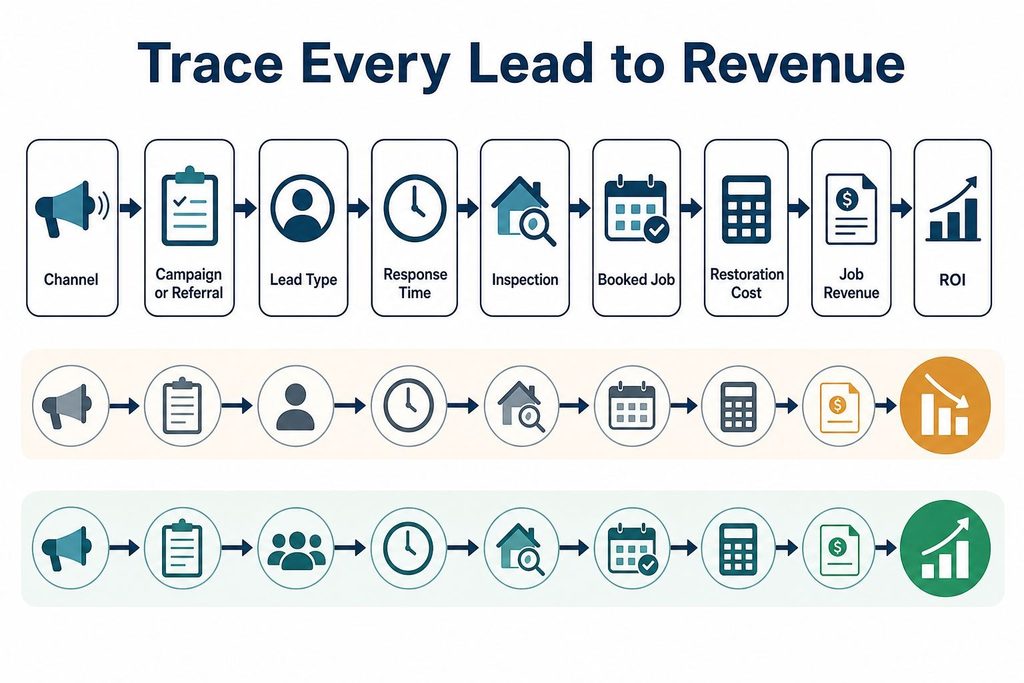
Missing any one link breaks the ability to see whether a channel that looks cheap on cost per lead is actually expensive once low conversion and small job size are factored in, or whether a channel that looks expensive is in fact the most profitable one in the business.
A Monthly Review Should Look at That Full Chain, Not Just Spend Against Lead Count
Weak message-channel combinations get paused, not defended by habit.
Channels with a longer payoff horizon, particularly organic search engine optimization and referral relationships that take months to mature, should be protected from short-term budget cuts once the data shows they are producing traceable, profitable outcomes.
Reallocation only happens once outcomes are actually traceable end to end; moving money based on lead count alone repeats the exact mistake the tracking chain exists to prevent.
Activate the First Forty-Eight Hours
None of the channel comparisons or messaging distinctions matter until they are converted into a short sequence of concrete actions, ordered so that each step protects the value of the one after it.
- Start with the profitable-job definition and the intake fields, because every channel decision, message, and tracking field downstream depends on knowing which jobs the business is actually trying to win. Without that definition first, every later step is built on a guess about what counts as a good lead.
- Next, correct the Google Business Profile and the priority service pages, since this is where urgent searchers are already arriving and any gap here is losing qualified demand for free, before a dollar of paid spend is committed. This has to happen before new channel spend because it is currently costing nothing to fix and everything to leave broken.
- Then activate one measurable high-intent campaign or referral outreach path, choosing a single channel rather than several at once, so its results can be read cleanly against the tracking chain already defined. Running one channel first, not five, is what makes the next step possible to interpret honestly.
- Finally, build the source-to-booked-job tracker, the record that turns the first three actions from separate activities into a single accountable system. This step comes last on the list but should be owned first in practice: assign the tracking sheet to a named person before spending another dollar on a new channel. Everything else in the sequence produces leads. Only this step produces the ability to know, with confidence, which of them were worth having.
About the Author